
AI Readiness in the Caribbean: The CARICOM AI Policy Roadmap
The rapid growth of Artificial Intelligence (AI) has significantly altered the arena of international security, global governance, climate change, and economic development. This has prompted small island developing states (SIDS) like the Caribbean Community (CARICOM) to prioritise AI readiness. CARICOM has developed an AI governance framework with two main components, the 2021 CARICOM AI Policy Roadmap and the 2025 Caribbean Telecommunications Union (CTU) AI Task Force, to advance ethical and sustainable adoption of AI and strengthen the region’s standing in global AI governance. This brief finds that CARICOM’s collaborative approach can potentially promote development and mitigate non-conventional threats, including climate change. However, to ensure that AI innovation becomes a driver of resilience rather than vulnerability, challenges such as limited technological infrastructure and dependence on external actors need to be tackled effectively.
Introduction
In the past decades, while global conflicts have shifted from traditional confrontations to non-conventional threats, such as terrorism, tariff wars, algorithmic manipulation, information warfare, and cyberattacks1, climate change has also emerged as a major challenge to global governance and international security, significantly impacting public health and economic stability2. These threats have become interconnected and have been exacerbated by the 21st-century Artificial Intelligence (AI) revolution, thus creating vulnerabilities that require holistic regional and global response3.
Such non-conventional security threats are particularly concerning for small island and coastal states4, including those in the Caribbean Community (CARICOM), a regional intergovernmental organisation comprising twenty countries—fifteen member states and five associate members in the Americas5. Since its formation in 1973, CARICOM’s goal has been to promote political and economic cooperation amongst its members and provide them a platform to solidify their participation in global governance, coordinate shared priorities, and address common risks and challenges.
To address the growing opportunities and challenges created by AI, CARICOM has developed an AI governance framework, with two core initiatives: the 2021 UNESCO CARICOM AI Policy Roadmap6 and the 2025 Caribbean Telecommunications Union (CTU) AI Task Force7. While the UNESCO roadmap laid out the vision, the CTU AI Task Force reflects an operational shift toward implementation, as well as a new diplomatic and economic strategy, aiming to reduce reliance on external powers, safeguard data sovereignty, and promote inclusive and sustainable digital development. These recent measures by CARICOM to institutionalise AI governance indicate the region’s acknowledgement of AI-related risks as immediate and unavoidable that require coordinated and proactive planning to ensure that AI adoption is locally grounded, ethical, and equitable rather than being exploitative or passive.
This brief examines CARICOM’s evolving AI governance framework, highlighting its implications across environmental, cultural, economic, regional security, and digital governance sectors. It also underscores the dire need for collective, forward-looking AI strategies to safeguard the region’s future.
The UNESCO CARICOM AI policy Roadmap
The successful deployment of AI has the potential to address some of CARICOM’s persistent developmental challenges, such as low economic growth, high debt, and climate disasters8. The Caribbean Artificial Intelligence Policy Roadmap, published in June 2021 by UNESCO in collaboration with the Broadcasting Commission of Jamaica (BCJ), provides a regional AI policy framework focused on the Caribbean small island developing states (SIDS). The CARICOM AI Policy Roadmap is based on four foundational pillars—Culture and Creativity, Governance and Transformation, Upskilling and Education, and Resilience and Sustainability. The involvement of UNESCO in the formulation of this roadmap has enabled the prioritisation of the Caribbean’s cultural heritage and the promotion of its sustainable development as a central tenet of this policy.
The CTU AI Task Force
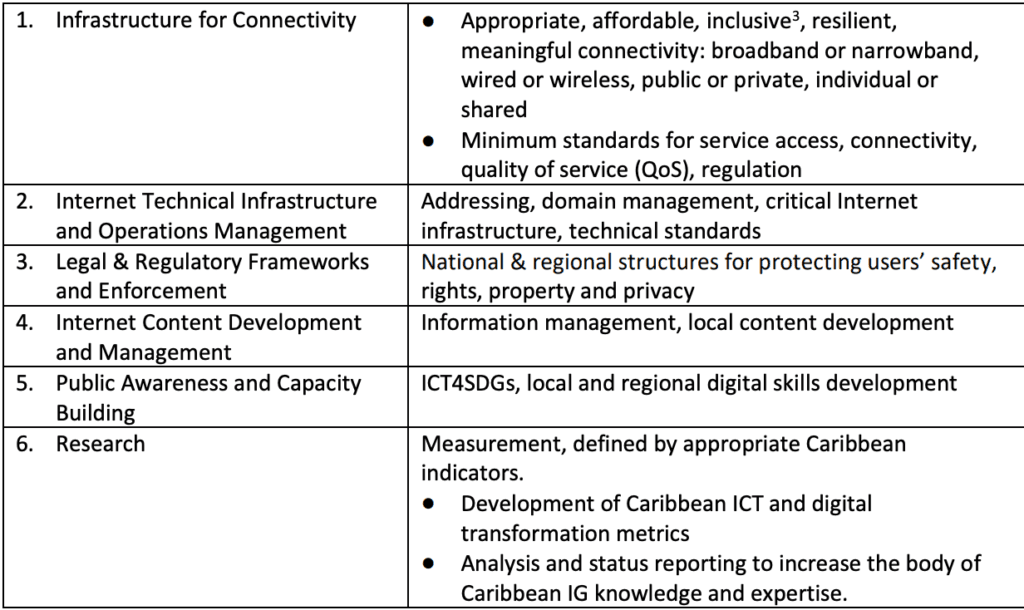
Building on the momentum from recent regional developments in AI regulation, the Caribbean Telecommunications Union (CTU) launched the Caribbean AI Task Force on 18th July 2025. This initiative aims to coordinate the development and governance of AI technology across the Caribbean. It reflects the region’s collective commitment to ensure that AI is developed and utilised in ways that mirror the Caribbean’s shared values, unique challenges, and aspiration for inclusive, resilient growth. The task force thus functions as a vital platform for the Caribbean to actively shape its own AI agenda, and formulate an internet governance framework, emphasising rights, equity, and empowerment9.
Implications of the CARICOM AI Blueprint
Economy
CARICOM regards AI as a catalyst for boosting productivity and creating new digital industries. The Jamaican Prime Minister, during the launch of the CTU AI Task Force, stated that AI should improve human skills by generating more skilled jobs rather than displacing workers, while also committing to AI labs and training programmes to develop a “cadre of coders” for the national digital economy7. Similarly, Barbados has taken steps to incorporate AI into agriculture by establishing an ‘AI Agronomic Advisor’, which aims to enhance efficiency in key export sectors10. Tourism, the region’s largest service industry, also stands to benefit significantly from AI-driven insights and automation.
The CARICOM AI Policy Roadmap stresses education and upskilling as vital to tackling low global AI funding in this region by integrating AI curricula and vocational training across the region to nurture local talents. This includes expanding coding academies and implementing “AI in schools”, which has already been adopted in Jamaica to provide personalised learning to children and youths11. Moving forward, CARICOM could prioritise formulating domestic and regional industrial policies that support tech startups and reskilling programmes to ensure that AI drives new investment and high-quality jobs, rather than widening inequality and unemployment.
Culture
AI impacts extend beyond economics and politics and demand cultural sensitivity. Since AI models are mainly trained on global data, which are predominantly Western, they often misinterpret local Caribbean languages and norms. This makes it necessary to integrate Caribbean dialects, patois, and creole into AI-driven chatbots and educational outreach/training programmes, particularly for women and youth12. The CARICOM AI Policy Roadmap highlights “Culture and Creativity” as a core aspect, recognising the need for preserving identity, local languages, and intellectual property. Increasing funding for AI applications in creative industries—such as music, heritage tourism, and regional language processing—may help strengthen and preserve cultural identity within the digital space.
Environment
Given that training large AI models consumes significant energy, the environmental impacts of AI are especially relevant for CARICOM states, as many Caribbean electricity grids depend on imported fossil fuels. The roadmap’s “Resiliency and Sustainability” pillar recommends green ICT policies, making the expansion of renewable energy sources, such as solar and wind, essential for data centre. Establishing “green” data centre incentives and adopting edge-computing models could help reduce consumption and harmful transmission. Since this region is vulnerable to natural disasters, strengthening AI infrastructures, such as ensuring backup systems for emergency power and critical servers, is also important. The roadmap proposes linking AI strategies with climate policies by developing AI frameworks that include standards for energy efficiency and emergency preparedness for digital systems.
Regional Digital Governance
Harmonised digital governance across borders is a key goal of the CARICOM AI Policy Roadmap. There is a need for country-level AI strategies that align with the broader CARICOM agenda, including rules for data sharing, model validation, and digital IDs, as well as regional applications such as health and education13. UNESCO’s roadmap calls for clear regulatory frameworks and oversight mechanisms for AI, while CARICOM agencies, such as the Caribbean Centre for Development Administration (CARICAD), provide guidelines on digital ID and advance regional e-government standards14. To ensure coherence and long-term alignment, CARICOM could take steps to expand ICT commissions or establish new agencies, technical committees, and regulatory bodies, which will operate cross-culturally, ensuring maintenance of data standards, ethics, and cybersecurity.
Regional Security and Data Sovereignty
Given AI’s heavy reliance on data, which raises immediate security and sovereignty concerns, CARICOM states are increasingly working to localise their data and computing resources. Guyana’s “Digital Guyana” programme, designed to create a sovereign AI cloud to keep government data within national borders, addresses concerns about the Caribbean region’s dependence on foreign cloud and financial networks15; this dependence also makes them vulnerable to sanctions or outages. Therefore, the roadmap recommends establishing regional data repositories and decentralised AI hubs. CARICOM-wide privacy rules based on GDPR could also be adopted to ensure AI systems respect citizens’ rights everywhere, and “algorithmic transparency” laws could help prevent black-box systems from concealing biases. A standard incident response protocol and training, such as through the CARICOM Cyber Security and Cybercrime Action Plan (CCSCAP), launched on 31st October 2025, is essential, along with investments in local cloud and edge networks, data centres, open-source platforms, and cross-border cyber drills to reduce reliance on foreign providers for cybersecurity, and to ensure data sovereignty16.
Also Read: A European Nuclear Backstop: Exploring France’s Potential Extended Deterrence for EU security
Conclusion
The emerging AI policy framework of the CARICOM marks an essential step towards a resilient, innovative, and future-ready Caribbean, ensuring a unified, coordinated digital governance structure. The emphasis on ethical safeguards and inclusive capacity building has already begun to shape the region’s digital diplomacy and discussions on data sovereignty.
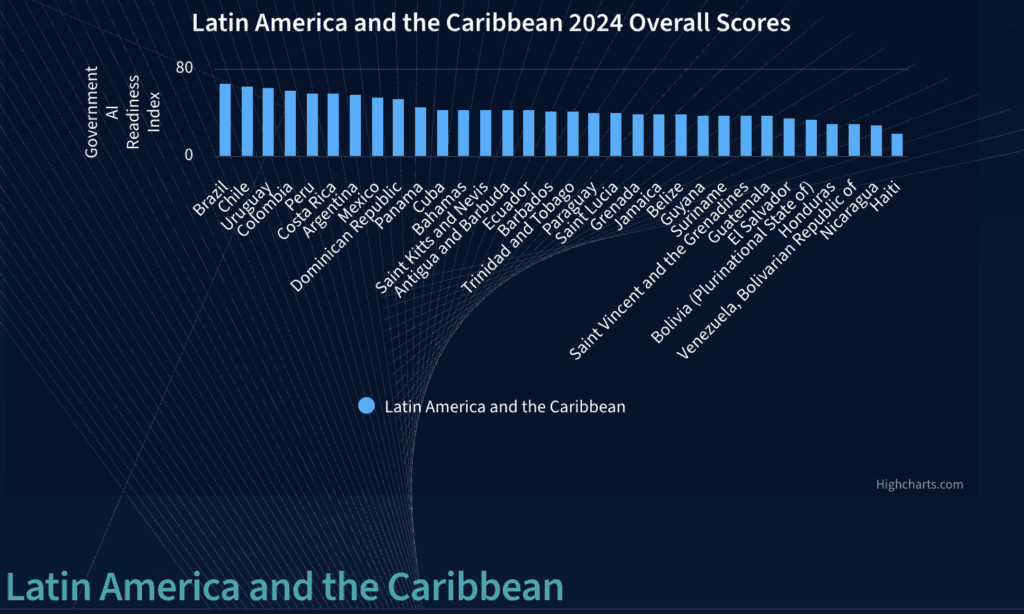
However, the CARICOM AI Policy is still in its early stages. To ensure effective implementation, greater collaboration with global partners and the development of strong public–private partnerships are required. Proactiveness would be key to ensuring fair access to digital infrastructure while supporting long-term sustainability, considering that the region is among the least prepared for AI, ranking low on global indices such as the Oxford Insights 2024 Government AI Readiness Index17.
Source: Oxford Insights
Some significant limitations include inadequate digital infrastructure, underdeveloped clean energy grids, weak cybersecurity, and an underdeveloped technology sector. These challenges, combined with rising geopolitical tensions disrupting the global supply chain, create obstacles for the CARICOM AI Policy because access to rare earth minerals, semiconductors, data hardware, software, and skilled talent is expensive and unreliable8. Trade conflicts also hinder CARICOM’s ability to establish long-term partnerships with leading AI technology providers, making digital diplomacy more difficult18.
Overcoming these limitations is possible through the adoption of a phased and sustainable implementation model accounting for the region’s high infrastructure costs and uneven digital capacity. Establishing a ‘Regional AI Innovation Hub’ would allow member states to pool resources and support shared research and development19. Furthermore, increased access to advanced AI training and research for the youth can be ensured through inclusion of AI and machine learning in educational curricula, skill-development and knowledge-transfer programmes, partnerships with regional as well as international universities, industries, and international organisations20.
To conclude, the Caribbean AI governance framework has the potential to be a successful endeavour by addressing existing gaps and preparing the Caribbean for the future of AI. These initiatives to develop a digitally resilient Caribbean can serve as an example for small states worldwide and exemplify how regional, collective efforts are effective ways to ensure equitable, efficient, and sustainable development, especially when the international order is more fragmented than ever. It can also pave the way for other nations to embrace the principle of common and shared responsibility, promoting greater inter-state cooperation to pursue not only national interests but also to support those in need.
About the Authors

Shreya Chandrashekhar
Associate Editor

The views and opinions expressed in this policy brief are those of the authors and do not necessarily reflect the official policy or position of Hegemoniq.
- United Nations. n.d. “A New Era of Conflict and Violence | United Nations. ↩︎
- Adger, W.N., J.M. Pulhin, J. Barnett, G.D. Dabelko, G.K. Hovelsrud, M. Levy, Ú. Oswald Spring, and C.H. Vogel. 2014. Human Security. Climate Change 2014: Impacts, Adaptation, and Vulnerability. Part A: Global and Sectoral Aspects. Contribution of Working Group II to the Fifth Assessment Report of the Intergovernmental Panel on Climate Change. ↩︎
- Economic Commission for Latin America and the Caribbean (ECLAC). n.d. “ILIA 2025: Consolidated as a Policy-Design Instrument for Artificial Intelligence in the Region.” ↩︎
- Brady, Anne-Marie, and Baldur Thorhallsson. 2020. Small States and the New Security Environment. Vol. 7. Springer Nature. ↩︎
- Caribbean Community (CARICOM). n.d. “Who We Are.” ↩︎
- UNESCO. 2024. “Caribbean Artificial Intelligence Policy Roadmap.” ↩︎
- Caribbean Telecommunications Union. 2025. “CTU Caribbean AI Task Force Launched to Guide Ethical and Inclusive Artificial Intelligence Development in the Region.” ↩︎
- Mohammed, Amir, and Sheikh Ahad Ahmad. 2025. “Development of AI in the Caribbean: Algorithms, Challenges and Recommendations.” Insights Into Regional Development 7 (1): 40–57. ↩︎
- Taylor, Rodney, and Caribbean Telecommunications Union. 2024. A Caribbean Internet Governance Policy Framework. Report. Caribbean Telecommunications Union. ↩︎
- Global Ag Tech Initiative. 2024. “Barbados Sets Global Example with AI Advisor for Agriculture.” September 2024. ↩︎
- Jamaica Teachers’ Association (JTA). 2024. “Education Ministry Testing AI Tools in Schools ↩︎
- Brookings Institution.February. 2025. “Integrating Caribbean Realities into Global AI Safety ↩︎
- UNESCO. 2022. Recommendation on the Ethics of Artificial Intelligence. SHS/BIO/PI/2021/1. ↩︎
- Caribbean Centre for Development Administration (CARICAD). n.d. “CARICOM.” ↩︎
- Department of Public Information, Guyana. 2025.“A New Digital Guyana: Bold Strategies Transforming Public Services, Data Security.” August 25, 2025. ↩︎
- CARICOM. 2025. “Updated CARICOM Cyber Security and Cybercrime Action Plan Launched.” November 2025. ↩︎
- Oxford Insights. 2025. “Government AI Readiness Index.” June 2025. ↩︎
- Mohammed, Amir, and Sheikh Ahad Ahmad. 2025. “Development of AI in the Caribbean: Algorithms, Challenges and Recommendations.” Insights Into Regional Development 7 (1): 40–57. ↩︎
- Phillip-Durham, Genève. 2024. “The Evolution of Diversification Discourse in the Caribbean in an Age of Generative AI-Policy and Praxis in Higher Education.” Journal of University College of the Cayman Islands. ↩︎
- Mohammed, Amir, and Sheikh Ahad Ahmad. 2025. “Development of AI in the Caribbean: Algorithms, Challenges and Recommendations.” Insights Into Regional Development 7 (1): 40–57. ↩︎