
India’s 2026 BRICS Presidency
“Reinvigorating Multilateralism in a Fragmented World Order”The year 2026 marks the 20th anniversary of the bloc, a milestone coinciding with India’s 2026 BRICS Presidency. Since the inaugural meeting of the Foreign Ministers in New York on September 20, 2006, the forum has evolved into the definitive voice of the Global South. Over the past two decades, it has moulded itself into a development, growth, and humanity-oriented platform, silently shaping the emerging multipolar world order.
Today, the rules-based order faces severe threats from states undermining international law and institutions like the United Nations, often choosing unilateral action to secure their interests. In this climate of geopolitical volatility, multilateral platforms such as BRICS are essential for bridging the gap between emerging economies. Under India’s 2026 BRICS Presidency, the agenda is to strengthen the bloc’s relevance through enhanced cooperation in technology, security, and trade, securing the Global South against imminent supply chain crises and economic downturns.
This brief examines why India’s ‘human-centric’ approach to the Chairmanship might be the critical intervention needed in a world more fragmented than ever before. Reinvigorating multilateralism through trust-building and strengthening partnerships offers a viable path forward to salvaging the international rules-based order.
Introduction
The Significance of India’s 2026 BRICS Presidency
This year marks 20 years since the inception of the Brazil, Russia, India, and China (BRIC) multilateral forum, which are united major emerging markets and developing countries worldwide. Over the past two decades, BRICS has broadened to become a more inclusive organisation, serving as a platform that unites nations of the Global South. South Africa officially joined the BRIC in 2011, and in 2024, Egypt, Ethiopia, Iran, Saudi Arabia, and the UAE gained membership. Indonesia became a member of the BRICS from January 2025, while several others — Belarus, Bolivia, Cuba, Kazakhstan, Malaysia, Nigeria, Thailand, Uganda, Uzbekistan, and Vietnam — joined as Partner Countries in 2025.1
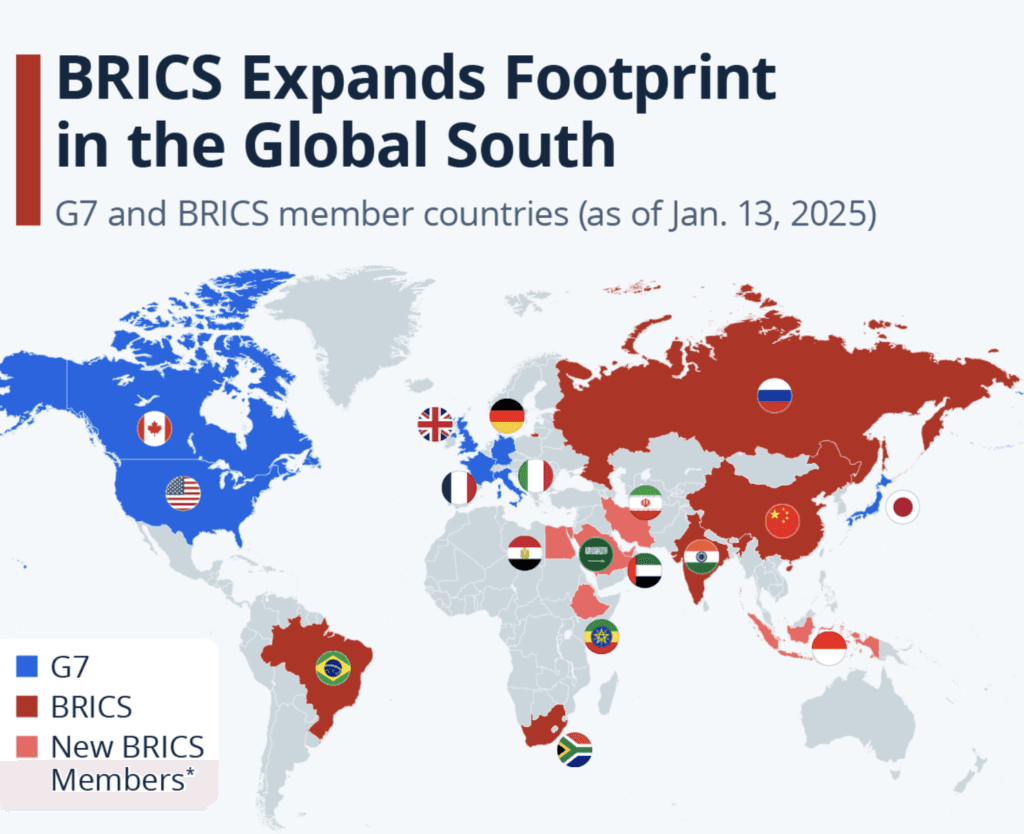
Image Source: Statista Research
Initially, the BRICS agenda focused mainly on economic issues of concern and development but over time BRICS cooperation has been substantially broadened to include consultation relating to a plethora of areas: from economy, trade, agriculture, energy security, infrastructure development, technology sharing, education, and cultural exchange to supplying chain disruptions and combating mutual threats such as terrorism, climate change, geopolitical conflicts on the regional and international levels.
As India assumes the BRICS Chairship in 2026, it does so amid significant geopolitical uncertainties and challenges affecting countries across regions. India’s BRICS Chairship is focused on a ‘humanity-first’ and ‘people-centric’ agenda, aligned with this year’s theme — “Building for Resilience, Innovation, Cooperation and Sustainability” — as announced by India’s Minister of External Affairs Dr S. Jaishankar, earlier this January. Emphasising the urgent need to strengthen cooperation, sustainable development, and state capacities, the theme sounds a clarion call for nations to focus on ‘reinvigorating multilateralism’ in a rapidly fragmenting international order.
This brief explores India’s approach to the BRICS Chairmanship in 2026 within an increasingly conflicted world order. It considers how India’s 2026 BRICS leadership aligns with its foreign policy strategies of ‘strategic autonomy’ and ‘multi-alignment’ and examines the frameworks India has implemented or will implement to present BRICS as a reformist rather than a revisionist force in the international system amid perceptions of it as an anti-Western platform.
Reinvigorating Multilateralism: The “Soul” Of The BRICS Manifesto
As of 2025, the BRICS and their partner countries accounted for approximately 49.5% of the world’s population, 40% of global GDP (PPP), and 26% of international trade. Over the years since its establishment, BRICS has managed to establish an intricate network of intergovernmental cooperation to combat collectively mutual issues faced by states of the Global South while collaborating on topics of shared interest by founding institutions dedicated towards this agenda, such as the Contingent Reserve Arrangement (CRA), established in 2014, and the New Development Bank (NDB), established in 2015.2
With the rise of the BRICS as a strong geoeconomic and geopolitical alliance, heralding the emergence of a post-Western, multipolar world order, the multilateral grouping is certainly viewed through contrasting perspectives, especially when compared to European alliances such as the G7 or the G20.
The past five years have been nothing short of challenging for the international rules-based order and the multilateral diplomacy, with conflicts erupting across regions of the world, be it the Russia-Ukraine conflict, the conflict between Israel and Palestine, or recent incidents related to Venezuela, Iran, or Greenland. These crises signal the subtle rise in what seems to be neo-imperialism disguised as security concerns to create exclusive spheres of influence.
The failure of international institutions such as the UN to ensure the restoration of peace and security, and the lack of regulation by financial institutions like IMF or WTO to ensure the smooth running of the global supply chain, only encourages the feelings of distrust to strengthen towards the rules-based international order.
In these polarising times, the BRICS has certainly made an effort to re-establish waning trust in international cooperation and multilateral diplomacy, as reflected in its ‘Kazan Declaration’ of 2024. Adopted by the BRICS and their Partner Countries at the 16th BRICS Summit held on 23 October 2024 in Kazan, hosted by the Russian Federation, the ‘Kazan Declaration’ focused on “Strengthening Multilateralism for Just Global Development and Security.”3 The declaration reiterated the commitment of the BRICS nations to improving global governance by promoting a more “agile, effective, efficient, responsive, representative, legitimate, democratic, and accountable international and multilateral system.” Through sharing resources, technology, energy, ideas, and culture, BRICS nations attempt to achieve individual goals through mutual cooperation and healthy competition rather than accumulating power and resources to undermine weaker states.
In sum, by bringing together different perspectives and agendas on one platform, the BRICS aims at reforming the existing chaotic international order to ensure inclusivity and collaboration rather than acting as a platform focused on the sole agenda of combating the West.
A Need of the Hour: India’s Humanity First Vision
In today’s uncertain geopolitical environment, as the international rules-based order is being undermined and greater powers focus on enforcing unilateral decisions and taking what they want at will, humanitarian issues have borne the brunt. Human rights questions such as climate induced migration, lack of essential facilities like food and medical help for civilians caught amidst geopolitical conflicts, are vastly neglected. During the inauguration of the BRICS logo and the theme for 2026 in his address the Minister of External Affairs of India Dr S. Jaishankar highlighted India’s “humanity first” approach to its 2026 BRICS Chairship4. This approach reflects India’s and the BRICS’s commitment to prioritising global welfare, inclusivity, and humanitarian aid and strengthening three foundational pillars of the BRICS — politics and security, economy and finance, cultural and people-to-people exchanges.
The ‘Humanity First Vision” also forms a core tenet of India’s own foreign policy. While post-independence Indian foreign policy has been dynamic and flexible, the focus has consistently been on maintaining India’s strategic autonomy, resisting external pressure, and building long-term partnerships with nations across the globe to promote innovation and sustainable development that benefits everyone through interconnectedness and interstate cooperation.
Several incidents highlight India’s role in providing humanitarian assistance during international crises. India has been consistently among the first responders worldwide and has supported over 150 countries in the past five years.5 Notable humanitarian operations conducted by India include: Operation Sagar Bandhu (2025), launched to assist Sri Lanka in the aftermath of the devastating Cyclone Ditwah by providing 1058 tonnes of relief material, including food and medicines, and by setting up an Indian Army Field Hospital which treated over 3,300 patients6; Vaccine Maitri, through which India supplied approximately 30 crore vaccine doses to less developed and vulnerable countries — many free of cost. — during the COVID-19 pandemic, prioritising equitable access to vaccines for all in times of global crisis7; and Operation Sadbhav (2024) which provided 53 tonnes of flood relief to Myanmar, Laos and Vietnam following Typhoon Yagi8. In addition, as of 2025, India also holds the record for the highest number of personnel deployed to UN Peacekeeping Missions over the last 75 years, further reflecting India’s humanity-first, global welfare-oriented foreign policy, rooted deeply in its civilisational ethos.9
All in all, India’s humanity-centric theme for its 2026 BRICS Chairship is aimed at bringing back the bloc’s agenda the focus from individualistic agendas towards pressing concerns relating to non-traditional security threats and all-inclusive development.10
Read the Interview: Navigating a Multipolar World: In Conversation with the High Commissioner of South Africa in India Mr Anil Sooklal
The Art Of Multi-Alignment
The World Economic Forum (Davos, January 2026) has predicted subdued global economic growth in 2026 due to elevated trade tensions and uncertain fiscal conditions. Presenting the World Economic Situation and Prospects 2026 report at the UN House in New Delhi, Chris Garroway, the UN country economist for India, stated that despite elevated global uncertainties, India remains on course to be the fastest-growing major economy in 2026, with its growth projected to moderate from an estimated 7.4% in 2025 to 6.6% in 2026 powered by resilient domestic demand and strategic investment.11 India’s foreign policy of multi-alignment — a pragmatic shift from the Cold War-era Non-Alignment policy — has certainly catalysed the nation’s economic growth by diversifying and expanding its access to global resources.
Taking into account intensifying pressure from the US in the form of tariff threats, and India’s longstanding strategic partnership with Russia focused on defence, energy, and security cooperation.12. India experiences differences in opinions with its BRICS partner China over matters related to territorial disputes. India chooses to selectively cooperate with China in multilateral platforms such as the G20, SCO or the BRICS. Navigating through these cross-currents, India has successfully managed to keep a pro-Global South approach in multilateral settings, be it the G20 or the BRICS. It seeks to advocate the voice of the Global South while also focusing on building strong bilateral partnerships with Western countries. From recent India-EU Free Trade Agreement13 to India’s outreach to the Weimar Triangle (a trilateral grouping consisting of Germany, France, and Poland14), and to the 2026 security agreement with the UAE15 India has shown willingness to build long-term strategic, mutually beneficial partnerships with states across the globe.
In response to external pressure, tariff threats, and escalation of differences, India has chosen a non-confrontational strategy rooted in diplomacy, dialogue, and mutual respect as Chair of the BRICS in 2026, showcasing the bloc as forum dedicated to upholding the international rules based order through value-cherishing agreements rather than a bloc driven by transactional policies and political agendas.
Conclusion
For decades states — either large, middle, or small — all have relied on multilateral institutions such as the UN, IMF, WTO for problem solving and ensuring inclusivity and equality within the international order. Nevertheless, with the deep deterioration of the very organisations they relied upon, states, especially the smaller and the middle powers, had to turn into isolationist fortresses. Today every state relies on the grave importance of building strategic autonomy in vital areas such as food, energy, critical minerals, and economy to ensure survival, security, and sustainable development in a world where rules no longer protect16. In recent times international relations have undergone a drastic shift from long-term partnerships based on cooperation and dialogue to transactions of egos.17
With open challenges to international law and order, whether it is Venezuela, Ukraine, or Taiwan, BRICS has a very important role to play as all middle powers gather and ensure that they are safeguarded. With India taking over the BRICS Chairship in 2026, the bloc has an opportunity to ensure multilateralism and the strength of dialogue thrive in a world with hegemonic powers dictating the terms through show of force and coercive economic measures.India as the Chair of the BRICS and its thoughtfully developed partnerships with states across the world place it in a beneficial position as a ‘bridge-builder’. One of the best examples of this is the joint declaration of the G20 on Ukraine unanimously adopted in 2023. Unlike the Bali Declaration which was unable to forage consensus, the New Delhi Declaration of 2023 was able to broker a breakthrough due to New Delhi’s good relations with both Russia and the West18. India’s vast network of carefully built partnerships based on mutual interests, cooperation, and dialogue is a clear reflection of its successful ‘multi-alignment’ foreign policy.
In conclusion, India’s BRICS chairship of 2026 is likely to help bring together varied perspectives, agendas, and interests at the same table and is aimed at shared goals through compromise, dialogue, and diplomacy. As geopolitical volatility intensifies, India calls upon emerging and middle powers to work together to combat the rise of hard power and hegemonic tendencies to build a more resilient and egalitarian rules based order.
Credits

The views and opinions expressed in this policy brief are those of the authors and do not necessarily reflect the official policy or position of Hegemoniq.
Endnotes
- Patrick, Stewart, Erica Hogan, Oliver Stuenkel, Alexander Gabuev, Ashley J. Tellis, Tong Zhao, Gustavo De Carvalho, et al. (March 31, 2025. ). “BRICS Expansion and the Future of World Order: Perspectives From Member States, Partners, and Aspirants.” Carnegie Endowment for International Peace. ↩︎
- Patrick, Stewart, Erica Hogan, Oliver Stuenkel, Alexander Gabuev, Ashley J. Tellis, Tong Zhao, Gustavo De Carvalho, et al. (March 31, 2025. ). “BRICS Expansion and the Future of World Order: Perspectives From Member States, Partners, and Aspirants.” Carnegie Endowment for International Peace. ↩︎
- BRICS countries.(October 23 2024). “XVI BRICS Summit Kazan Declaration.” ↩︎
- Ministry of External Affairs, Government of India.(January 13 2026) “EAM’s Address During The Launch of BRICS India 2026 Logo, Theme And Website.” n.d. https://www.mea.gov.in/Speeches-Statements.htm?dtl/40586. ↩︎
- Press Information Bureau.(January 27 2026).“India Led With Compassion During COVID-19, Sharing 300 Million Vaccines Globally: Union Minister of Commerce & Industry Shri Piyush Goyal.” n.d. https://www.pib.gov.in/PressReleasePage.aspx?PRID=2124745®=3&lang=2. ↩︎
- Ministry of External Affairs, Government of India. (December 9 2025). “Operation Sagar Bandhu Continues Providing Emergency HADR Support to Sri Lanka Following Cyclone Ditwah.” n.d.https://www.mea.gov.in/press-releases.htm?dtl/40420/Operation+Sagar+Bandhu+continues+providing+Emergency+HADR+Support+to+Sri+Lanka+following+Cyclone+Ditwah. ↩︎
- Press Information Bureau.(January 27 2026).“India Led With Compassion During COVID-19, Sharing 300 Million Vaccines Globally: Union Minister of Commerce & Industry Shri Piyush Goyal.” ↩︎
- Ministry of External Affairs, Government of India.(September 17 2024). “Operation Sadbhav: India Sends 53 Tonnes of Emergency Flood Relief Assistance Worth US$ 1 Million to the Union of the Republic of Myanmar.” ↩︎
- Press Information Bureau.(March 9 2025).“India’s Legacy in UN Peacekeeping: Leadership, Commitment, and Sacrifice.” ↩︎
- Lima Carlos Lucas. The Diplomat. (January 16, 2026). “India’s 2026 BRICS Presidency: Multilateralism, Multipolarity, and the Venezuelan Test.” ↩︎
- United Nations- India. (January 9 2026). “India to See 6.6% Growth in 2026 Amid Global Headwinds: Report.” ↩︎
- Lima Carlos Lucas. The Diplomat. (January 16, 2026). “India’s 2026 BRICS Presidency: Multilateralism, Multipolarity, and the Venezuelan Test.” ↩︎
- Press Information Bureau.(January 27 2026). “India–EU Free Trade Agreement Concluded: A Strategic Breakthrough in India’s Global Trade Engagement.” ↩︎
- The Europe India Journal. (January 17, 2026. )“India’s EAM Jaishankar Breaks New Ground at Weimar Triangle Summit in Paris.” ↩︎
- Ramachandran, Sudha. The Diplomat. (January 22 2026). “India, UAE Embark on a Strategic Defense Partnership.” ↩︎
- World Economic Forum.(January 20, 2026. ) “Davos 2026: Special Address by Mark Carney, Prime Minister ofCanada.” ↩︎
- Bashirov, Galib, and Ihsan Yilmaz. (2020). “The Rise of Transactionalism in International Relations: Evidence from Turkey’s Relations with the European Union.” Australian Journal of International Affairs 74 (2): 165–84. ↩︎
- Biswas Soutik, PandeyVikas.BBC.(September 10, 2023). “G20: How Russia and West Agreed on Ukraine Language.” ↩︎