
Executive Summary
From Battery Rules to Data Governance: How the EU Is Reshaping China-Europe Supply Chains
The European Union’s Batteries Regulation is turning environmental regulation into supply-chain data governance. Companies must not only manufacture safe and lower-carbon batteries, they must also provide information on carbon footprints, raw-material origins, due-diligence risks, and recovery. From 2027, selected batteries will require digital battery passports (European Parliament and Council of the European Union 2023, 2025).
This shift matters greatly for Chinese industry. In 2025, China accounted for more than 80 percent of global battery-cell production. Chinese producers supplied almost 75 percent of batteries deployed in electric vehicles worldwide and more than half of the European Union market (International Energy Agency 2026). European customers will therefore need data from Chinese cell makers, materials producers, and other upstream suppliers.
This brief describes the emerging mechanism as trusted-data market access. Access to the European market will depend not only on price, capacity, and technical performance, but also on a firm’s ability to provide reliable, traceable, and verifiable supply-chain data. The EU should clarify implementation rules, China and the EU should establish a technical dialogue, and Chinese firms should build durable data-governance systems before the 2027 obligations take effect.
Green Rules Are Becoming Data Rules
The EU Batteries Regulation appears to be an environmental measure, but its reach goes far beyond product standards. It is creating a governance system that follows a battery from raw-material extraction through manufacturing and use to recycling. Firms must explain where materials originate, how much carbon is emitted, whether recycled content is used, and which environmental or social risks exist along the supply chain. Some of this information will be stored and shared through digital battery passports (European Parliament and Council of the European Union 2023).
Given the dominant position of Chinese companies in global and European battery markets, the regulation will not affect only direct exporters. Its requirements will travel through customer relationships to materials producers, component manufacturers, and other upstream firms. European vehicle manufacturers and importers cannot complete carbon declarations, due-diligence reviews, or battery passports without requesting more detailed information from their suppliers (European Parliament and Council of the European Union 2023; Rizos and Urban 2024).
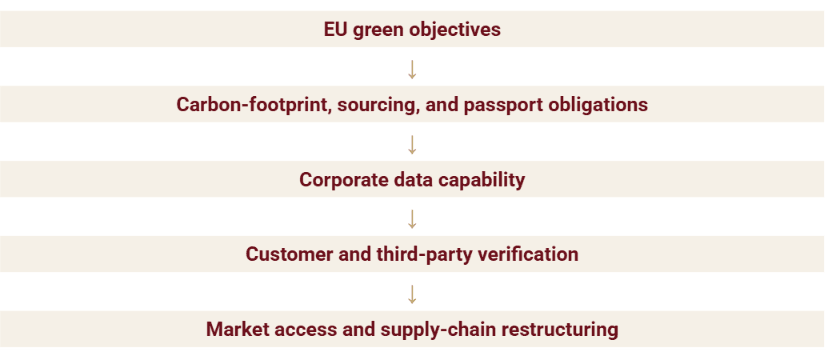
The regulation may be understood as a sector-specific expression of the Brussels Effect: the EU uses the attraction of its market to transmit its rules to businesses outside of its territory (Bradford 2020). This brief calls for the more specific mechanism of trusted-data market access. Firms must not only supply a compliant battery – they must produce credible evidence that the wider supply chain meets EU requirements. Control over data standards, verification methods, and access rights can therefore shape compliance costs, supplier selection, and industrial competition.
From Carbon Footprints to Battery Passports
The regulation creates three connected data obligations.
First, relevant electric-vehicles, light means of transport (LMT), and industrial batteries will gradually require carbon-footprint declarations. The assessment extends beyond direct factory emissions to raw-material acquisition, manufacturing, transport, and end-of-life treatment. The European Commission’s Joint Research Centre is developing common calculation and verification methods so that results can be compared across products and firms (European Commission, Joint Research Centre 2025). Companies must explain not only the final figure, but also the underlying data, boundaries, and methods.
Second, operators subject to battery due diligence must trace cobalt, natural graphite, lithium, and nickel; assess environmental, labour, and human-rights risks;explain their preventive or remedial measures. Manufacturers will therefore need information from upstream suppliers and records that can withstand independent review. Following the 2025 amendment, these obligations will apply from 18 August 2027 (European Parliament and Council of the European Union 2023, 2025).
Third, from 18 February 2027, electric-vehicle batteries, light means of transport (LMT) batteries, and industrial batteries above 2 kWh will require electronic records accessible through a QR code. The passport will connect information on composition, carbon footprint, sourcing, performance, repair, and recycling. Access will be tiered: some information will be public, while commercially sensitive data will be available only to regulators or actors with a legitimate interest (European Parliament and Council of the European Union 2023).
The common principle is simple. Firms will not merely have to meet an environmental standard; they will have to prove compliance through complete, comparable, traceable, and verifiable data.
Why Chinese Firms Face More Than Compliance Costs
The first challenge is methodology. Carbon-footprint results vary with system boundaries, energy mixes, databases, and modelling assumptions. If a Chinese firm’s internal method differs from the EU approach, data may need to be recollected, converted and explained before European customers or assurance providers accept it (European Commission, Joint Research Centre 2025). This is not a translation exercise: firms must show that factories, products, and suppliers use consistent methods.
The second challenge is the depth of the supply chain. Lithium, nickel, cobalt, and graphite pass through mining, refining, materials processing, and transport. Final data quality depends on each tier. Some suppliers can provide only averages, estimates or records in incompatible formats. Research with battery-value-chain actors finds that required information is often unavailable, differently defined, or difficult to transfer between organisations (Berger et al. 2023).
The third challenge is organisational. Data systems must be maintained as products, factories, and suppliers change. The Global Battery Alliance’s 2026 operational trials illustrate the task. Sunwoda tested coordination across business, sustainability, quality, information-technology, and supply-chain teams. REPT BATTERO combined data collection with third-party assurance and downstream-customer participation. Battery passports are therefore not a one-department filing exercise; they require cross-functional and value-chain collaboration (Global Battery Alliance 2026).
The fourth challenge is confidentiality. Supplier lists, formulas, purchase terms, and production processes have commercial value. CEPS research identifies data silos, limited interoperability, uncertain data reliability, and concerns over disclosure of sensitive information as major implementation barriers (Rizos and Urban 2024). Transparency must therefore be matched with clear access controls.
Chinese firms do not face a one-off reporting task. They need systems that can produce, update, share selectively, and defend supply-chain data over time.
Market Access Is Becoming Trusted-Data Access
The EU does not need to supervise every upstream company in China directly. It can impose duties on manufacturers, importers, and other operators placing batteries on the European market. These actors will then request data through contracts, customer audits, and third-party assurance. Commercial relationships transmit the regulatory requirement across borders.
Data capability will consequently become part of competitiveness. Price, production scale, and technology will remain important, but they will no longer be sufficient. A supplier that can deliver standardised, verifiable, and regularly updated data is better placed to answer customer requests and pass assurance checks. A low-cost supplier with fragmented records may face further scrutiny, delayed approval or replacement.
Digital battery passports are intended to reduce information breaks between manufacturing, use, repair, and recycling and to provide a shared database for different actors (Berger, Schöggl, and Baumgartner 2022). They may also alter supplier choices. Chinese producers may favour upstream partners that can provide stable sourcing and emissions data, while European customers may add transparency and system compatibility to procurement criteria. Some companies may build assurance, data-management or production capacity in Europe to reduce the information distance from customers and regulators.
These outcomes are not yet universal. They are reasonable inferences from the regulation, current data barriers, and purchasing incentives (Berger et al. 2023; Rizos and Urban 2024). The direction, however, is clear: firms will increasingly need trusted evidence (not merely green claims) to preserve market access.
Three Policy Priorities
Make EU Implementation Clearer and More Predictable
The European Commission, Joint Research Centre, and relevant standardisation bodies should consolidate guidance on carbon methods, data fields, verification, access rights and update cycles. Common templates and phased support for smaller firms would reduce repeated data conversion and legal uncertainty.
Establish a China-EU Technical Dialogue
China and the EU should establish a technical dialogue on battery-supply-chain data. It should focus on life-cycle calculation methods, interoperable data fields, the recognition of assurance providers, and the protection of commercially sensitive information. Full regulatory alignment is unrealistic, but technical compatibility can reduce duplicate calculation and verification. International battery-passport trials already provide a practical setting for testing shared formats and assurance methods without transferring ownership of confidential data (Global Battery Alliance 2024, 2026).
Move Chinese Firms from Reactive Compliance to Data Governance
Before the 2027 obligations take effect, companies should assign clear responsibility for carbon data and battery passports, include traceability requirements in purchasing contracts, and audit high-risk suppliers. Information systems should cover procurement, production, transport, use, and recycling. Firms should also control access, preserve calculation histories, and integrate carbon, confidentiality, and supply-chain risks into ordinary business decisions. Compliance investment can then support lasting customer relationships rather than a single filing.
Conclusion
The EU Batteries Regulation is expanding market access from product compliance to data compliance. Chinese companies will need not only to manufacture batteries that meet European standards but also provide supply-chain information that is credible, traceable, and open to verification.
Green industrial competition is therefore becoming a contest over data standards and regulatory reach. The Batteries Regulation forms part of the EU’s wider strategy for green industry and standard-setting. Whether its rules increase transparency without creating unnecessary duplication or risks to commercial information, the EU’s Regulation will help determine the future stability and restructuring of China-EU battery supply chains.
Credits

Li Yang
PhD candidate at Ghent University, Belgium, and a researcher involved in the Horizon Europe ReConnect China project.

Long Ting
Researcher in the Department of Interdisciplinary Study of Law at Ghent University, Belgium.

Polina Digo
Associate Editor, Hegemoniq
The views and opinions expressed in this policy brief are those of the authors and do not necessarily reflect the official policy or position of Hegemoniq.
References
Berger, Katharina, Josef-Peter Schöggl, and Rupert J. Baumgartner. 2022. “Digital Battery Passports to Enable Circular and Sustainable Value Chains: Conceptualization and Use Cases.” Journal of Cleaner Production 353: 131492. https://doi.org/10.1016/j.jclepro.2022.131492.
Berger, Katharina, Rupert J. Baumgartner, Martin Weinzerl, Johann Bachler, Kees Preston, and Josef-Peter Schöggl. 2023. “Data Requirements and Availabilities for a Digital Battery Passport: A Value Chain Actor Perspective.” Cleaner Production Letters 4: 100032. https://doi.org/10.1016/j.clpl.2023.100032.
Bradford, Anu. 2020. The Brussels Effect: How the European Union Rules the World. New York: Oxford University Press. https://doi.org/10.1093/oso/9780190088583.001.0001.
European Commission, Joint Research Centre. 2025. “Calculating the Carbon Footprint of Industrial Batteries: A Methodological Support.” May 28. https://joint-research-centre.ec.europa.eu/jrc-news-and-updates/calculating-carbon-footprint-industrial-batteries-methodological-support-2025-05-28_en.
European Parliament and Council of the European Union. 2023. “Regulation (EU) 2023/1542 Concerning Batteries and Waste Batteries.” Official Journal of the European Union L 191, July 28. https://eur-lex.europa.eu/eli/reg/2023/1542/oj.
European Parliament and Council of the European Union. 2025. “Regulation (EU) 2025/1561 of 18 July 2025 Amending Regulation (EU) 2023/1542 as Regards Obligations of Economic Operators Concerning Battery Due Diligence Policies.” Official Journal of the European Union, July 30. https://eur-lex.europa.eu/eli/reg/2025/1561/oj.
Global Battery Alliance. 2024. “Global Battery Alliance Launches Second Wave of Battery Passport Pilots.” June 20. https://www.globalbattery.org/press-releases/gba-launches-second-wave-of-battery-passport-pilots/.
Global Battery Alliance. 2026. “2026 Battery Passport Operational Trials.” Accessed August 25, 2026. https://www.globalbattery.org/2026-battery-passport-pilots/.
International Energy Agency. 2026. “Electric Vehicle Batteries.” In Global EV Outlook 2026. Paris: International Energy Agency. https://www.iea.org/reports/global-ev-outlook-2026/electric-vehicle-batteries.
Rizos, Vasileios, and Patricia Urban. 2024. Implementing the EU Digital Battery Passport: Opportunities and Challenges for Battery Circularity. CEPS In-Depth Analysis 2024-05. Brussels: Centre for European Policy Studies. https://www.ceps.eu/ceps-publications/implementing-the-eu-digital-battery-passport/.