
Between Principle and Pressure: India’s Strategic Autonomy in the age of G2 Competition and Tariff Diplomacy
Moving Beyond Defensive Neutrality Toward Proactive Agenda-Setting PowerIndia’s doctrine of strategic autonomy, tested and developed in the post-colonial era of non-alignment and refined into pragmatic “multi-alignment” today, is facing a structural reckoning. As the US-China rivalry hardens into a de facto G2 order, alongside Russia, another systemic actor, Washington demands binary commitments from its partners.
India’s carefully cultivated equidistance is being read not as principled independence but as strategic ambiguity. The 2025 tariff confrontation over Indian purchases of Russian crude exposed a fundamental paradox: a doctrine designed to preserve freedom of maneuver is tested when the international system no longer rewards neutrality.
This brief argues that the global community must look at how India’s Strategic Autonomy must move beyond the defensive logic of autonomy defined by what it refuses, towards a proactive model of indispensability—one that converts its unique positioning between competing blocs into genuine agenda-setting power.
Introduction
India is in a foreign policy paradox since 2022 with pragmatism and realism taking center stage in the global power politics changing the nature of alignments. The Russia-Ukraine war, Israel-Palestine conflict and the ongoing West-Asian crisis have testified the tilt in favour of hard-power potential from the soft-power diplomacy. This evolving crisis landscape has also exposed the centrality of energy security in foreign policy decision-making, where access to critical resources is increasingly shaped by geopolitical alignments and strategic flexibility. The post-Cold War era and the emergence of multipolarity has divided the world into the Global North and South. After the USA’s policy of “Pivot to Asia”, India was viewed as the counter-balance of the rising Chinese power. The emergence of the term “Indo-Pacific” as opposed to the previously existing term of “Asia-Pacific” to address the region depicts the centrality given to the Indian Ocean Region and India as a prominent stake-holder in ensuring peace and “rules-based order” in this region alongside acting as the “net security provider” of the global south.
However, after the return of Donald Trump to the White House, the US foreign policy has focused on a protectionist agenda with MAGA (Make America Great Again) as the main theme withdrawing from funding global and multilateral associations.1 The US has started to focus more on its domestic and regional policy rather than the areas of the Indo-Pacific and other regions. This can be observed by the withdrawal of the US from 66 international organizations like WHO, Paris Agreement, UNFCCC, IPCC, UN Human Rights Council, UNESCO, UNRWA, and other bodies with Secretary of State Marco Rubio characterising the organizations as “anti-American, useless, or wasteful.”2 The imposition of tariffs and tighter visa restrictions have shown the changing nature of the US foreign policy. India’s decision to dramatically scale up its purchases of discounted Russian crude oil despite the imposition of sanctions on Russia by the USA, from below 3 % of its total oil imports to an estimated 35% to 40%3 set in motion a slow-burn crisis with Washington that grew in the summer of 2025 into a full-blown trade confrontation, testing the limits of a foreign policy doctrine that New Delhi has cultivated for eight decades.
India’s defining foreign policy posture is the doctrine of strategic autonomy. It is historically rooted in the Non-Aligned Movement (NAM) of the Cold War period, and recalibrated in the post-Cold War era into what the current dispensation prefers to call multi-alignment.4 In order to understand how India has navigated the Russia-Ukraine conflict, US tariff pressure, and the G2 gravitational pull between Washington and Beijing, it is necessary to trace this doctrine from its Nehruvian origins to its present-day pragmatic expression, and then examining whether its core logic still holds in a world that increasingly demands binary choices.
The Nehruvian Foundation: Non-Alignment as Strategic Autonomy
The first declaration of the independence of India’s foreign policy was announced in a radio broadcast by Jawaharlal Nehru in 1946 which predates the formal independence. He said, “We propose, as far as possible, to keep away from the power politics of groups, aligned against one another, which have led in the past to world wars.” It was a strategic calculation by a newly decolonized state entering a world bifurcated into two hostile blocks. The intellectual architecture of what would become the Non-Aligned Movement (NAM) was assembled across several milestones. V.K.Krishna Menon has first used the term “non-alignment” formally in his 1953 speech at the UN.5 The Panchsheel doctrine was subsequently articulated by Nehru as a framework for Sino-Indian relations. The Bandung Conference held in Indonesia in 1955 which brought together 29 Asian and African states, gave the movement its first collective institutional expression.6 Six years later NAM was formally constituted, co-founded by Nehru alongside Yugoslavia’s Josip Broz Tito, Egypt’s Gamal Abdel Nasser, Ghana’s Kwane Nkrumah and Indonesia’s Sukarno.7
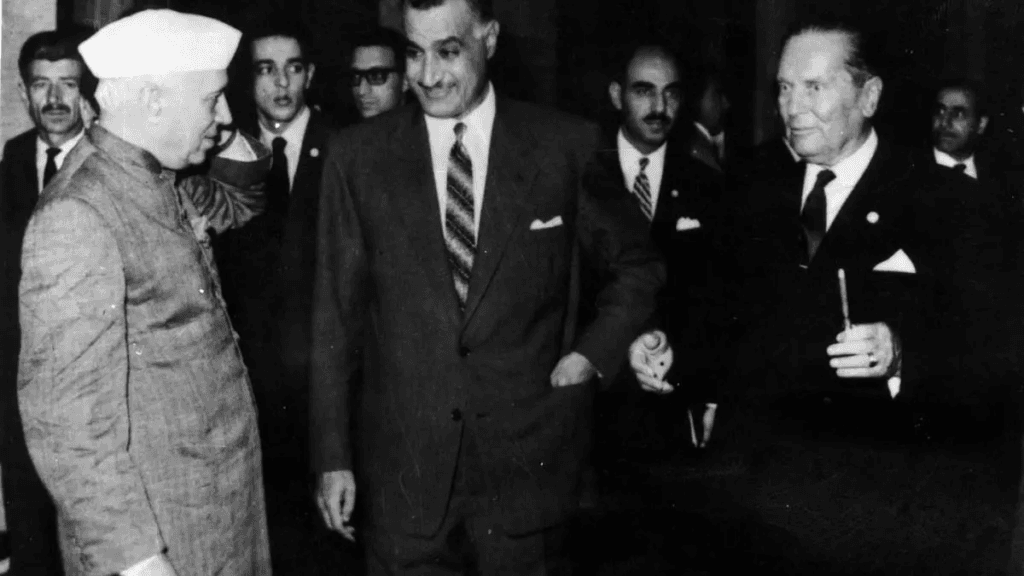
At its core, non-alignment was a project of sovereignty. For newly decolonised countries, the strongest desire was to refuse subordination, whether to Washington or Moscow. One scholar writes of the origins of NAM: “The Non-Aligned Movement was born of the desire of newly independent nations to preserve their independence in the face of a complex international situation demanding allegiance to either of two warring superpowers.”8 Non-alignment served as the most practical option wherein India benefitted from both the blocs. It accepted American military assistance during the 1962 Sino-Indian war and signed the 1971 Treaty of Peace, Friendship and Cooperation with USSR which functioned as a strategic alignment9.
The Limits and Decline of NAM
After the death of Nehru, in 1964, Indian non-alignment inclined towards Moscow under Prime Minister Indira Gandhi. The Cold War ended in 1991 and the Soviet Union collapsed altering the strategic environment. The realist theories and predictions gave way to economic liberalisation and complex interdependence after the onset of globalisation. India’s LPG reforms (Liberalisation, Privatisation and Globalisation) led to growing convergence with the US. India’s decision of not attending the 2016 NAM summit in Venezuela was emblematic of the fact that non-alignment had ceased to be India’s operative foreign policy doctrine10. It has been replaced by something more nuanced, more transactional and more demanding.
From Non-Alignment to Multi-Alignment: The Doctrine Recalibrated Strategic Autonomy in the Post-Cold War Era
The idea of strategic autonomy is the conceptual bridge between Nehruvian non-alignment and contemporary Indian foreign policy. “Strategic Autonomy” is the capacity to make independent foreign policy decisions without over-reliance on any single power.11 Strategic autonomy is defined by what India chooses to engage with and on its own terms as opposed to non-alignment which is defined by what India refused to join. As External Affairs Minister S. Jaishankar has written: “This is a time for us to engage America, manage China, cultivate Europe, reassure Russia, bring Japan into play, draw neighbours in, extend the neighbourhood and expand traditional constituencies of support.”12
This description, pragmatic, transactional, and emphatically plural, encapsulates the logic of multi-alignment. Unlike non-alignment, that claimed its moral high ground from being equidistant, multi-alignment is rooted in the phenomenon of issue-based alignment, whereby India aligns with different partners on different issues in accordance with the national interest calculus of each domain13. Security cooperation with the Quad, energy and development cooperation within BRICS, defense procurement from Russia, France, Israel and the US and trade deepening with the EU are not contradictions. They form the architecture of a policy crafted to extract maximum strategic value without precluding any option.
The conceptual difference between the two periods is significant. Non-alignment was an ideological construct in the first place. It claimed its moral high ground from its commitment to being equidistant from the two superpowers. It was rooted in the moral authority of newly independent states asserting their sovereignty. Strategic autonomy, on the contrary, is a pragmatic construct. It derives its authority from a realist vision of national interest. India is a member of QUAD for Indo-Pacific security and BRICS for alternative economic architecture without seeing these as in contradiction with each other14.
The Enabling Conditions: Why Multi-Alignment Worked
Multi-alignment was an effective tool in a globalised world with a US-dominated unipolar world order. This world order provided the space for India to be an autonomous actor. This was because the US was sufficiently invested in India’s economic integration, Russia needed market for its defence technology, and China was a rival India could cope with15. The post-liberal world, described by some analysts as the ‘Manmohan Singh doctrine,’ was one where India’s development needs dictated foreign policy, and India was free to have multiple parallel partnerships without any one of them being given priority16.
India is now a country of immense structural weight. It is the most populous country in the world, the fastest-growing major economy with a GDP over $4 trillion, and the fourth highest country by firepower on the Global Firepower Index.17 This is a world where India has acquired a strategic weight. Being a preferred partner for both the West and the Global South is not an aspiration but a reality.
The Russia-Ukraine Fault Line: Strategic Autonomy Under Pressure
The Russian military operation in Ukraine on 24 February 2022 confronted India with its most critical foreign policy dilemma in decades. Indian response was strategic and calibrated where in it abstained from several UN General Assembly resolutions aimed at condemning Russian actions, calling for an immediate end to hostilities citing its position of “strategic autonomy” and “national interest” in refusing to join western sanctions imposed against Moscow.18 The Indian government, while declaring itself “strongly against” the conflict, also announced its position “taking the side of peace,” trying to leave room for diplomacy with all the players19.
However, the approach shifted when energy policies were concerned. Until the beginning of 2022, Russia contributed merely 1% of Indian crude oil imports. In late 2023 and early 2024, Russian contributions increased dramatically, reaching around 35-40% at their peak. Consequently, Russia became India’s top oil supplier. India is inherently dependent on energy sources; it imports nearly 87% of its oil and is the world’s third-largest consumer of crude20. Given that Russian oil prices dropped owing to international sanctions, India’s decision was, according to Jaishankar, based solely on costs, risks, and availability.
The figures were self-explanatory when in December 2024, Rosneft (Russia’s largest oil company) signed the largest oil supply deal of nearly 500,000 barrels per day in India-Russia history.21 India simultaneously emerged as Ukraine’s biggest exporter of diesel fuel by July 2025, providing 15.5% of the country’s diesel fuel imports, with some of it speculated to be refined from Russian crude oil22. The geopolitical irony was not lost on observers: India was, in effect, running a resource processing corridor that served all parties.
The Tariff War: Washington’s Response
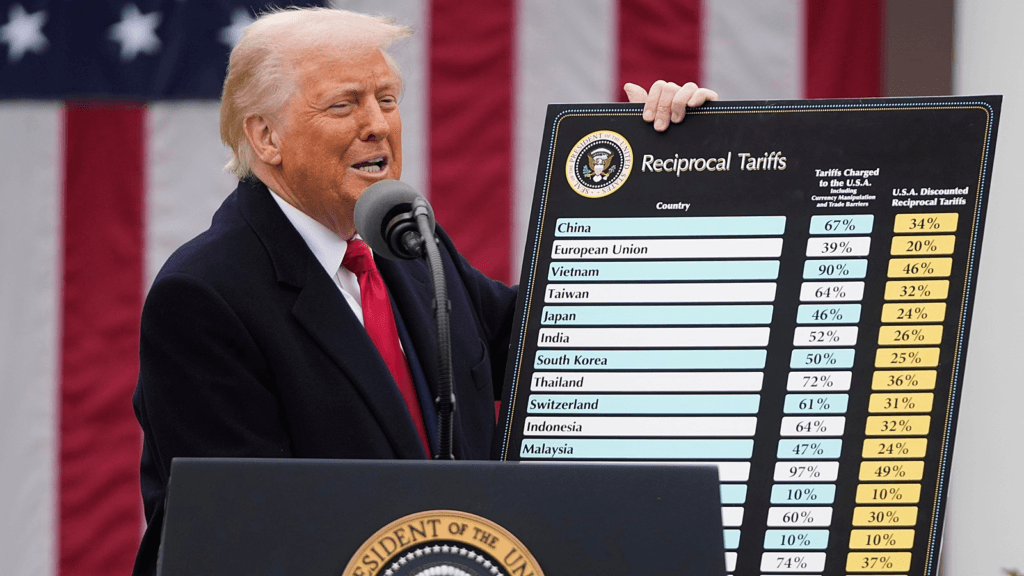
The Trump administration’s response when it returned to power in January 2025 was swift and punitive. The US placed a 25% secondary tariff against India’s purchases of Russian oil in addition to an existing 25% reciprocal tariff against Indian imports making it a total import tariff of 50% among the highest imposed on any trading partner23. Trade advisor Peter Navarro’s characterisation of India as a “laundromat for the Kremlin” encapsulated Washington’s position. India responded strongly by terming these new import tariffs as “unfair, unjustified and unreasonable”.24 The Indian foreign minister, S. Jaishankar speaking at the Munich Security Conference in February 2026 said, “We are very much wedded to strategic autonomy because it is very much a part of our history and our evolution… If the bottomline of your question is – would I remain independent-minded and make my decisions – yes, it can happen.”25 The imposition of the tariff system laid bare an inherent disparity that had long been concealed by India’s multi-alignment policy. Critics argue that India was targeted by imposition of sanctions when China, despite being a far larger purchaser of oil from Russia, faced no equivalent sanctions. It is here that the logic of strategy employed by the US becomes evident. China could not be sanctioned since it was a critical component of the global supply chain; Japan and Turkey, though buyers of oil from Russia, were part of US alliances. India, outside the purview of any formal alliance was the weakest link among these countries in the G2 framework strategy pursued by the US.
The G2 Trap
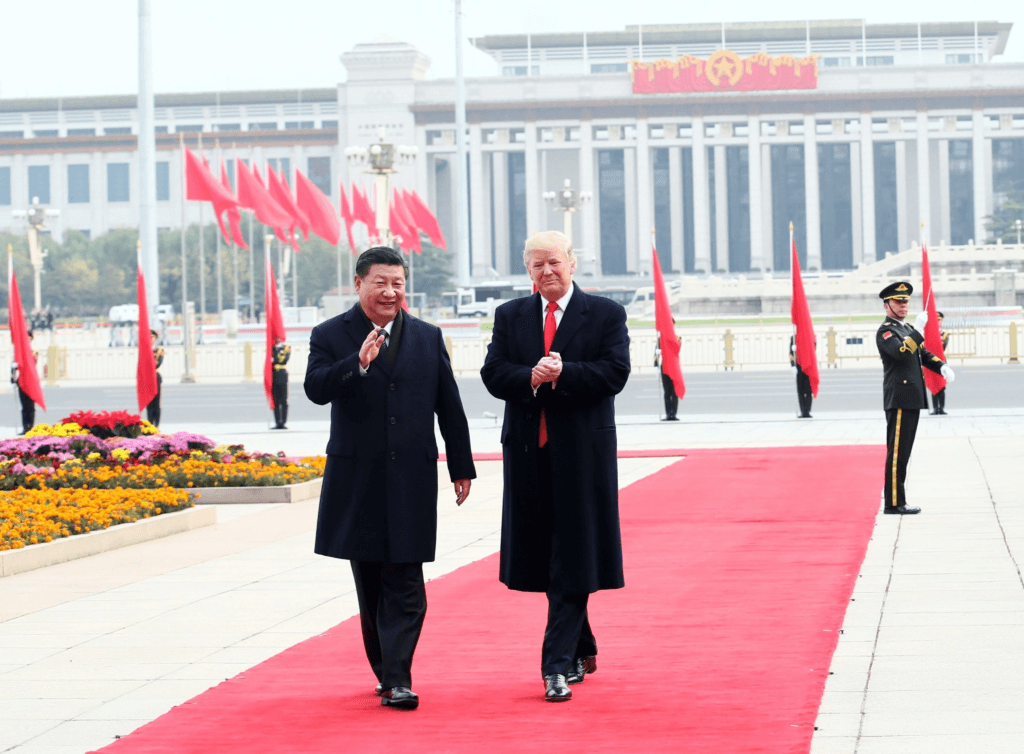
The idea of a G2, an informal condominium of US and Chinese power poses a challenge for India’s multi alignment doctrine. India’s strategy is sustainable in a truly multipolar world. In a world increasingly organized around US-China bipolarity, the space for genuine autonomy narrows. Every relationship India cultivates with Russia or China is viewed as a hedge against US pressure. However, the recent summit where Donald trump visited China has transformed the previous strategic calculus. The growing dependence on each other and the strategic proximity due to shared interests may affect India’s position as a major balancing power in the global South. China’s President Xi Jinping has said that the two sides had agreed to a “new positioning” for relations based on “constructive strategic stability”, however issued the warning that Taiwan remained the most sensitive issue.26
India is caught in what RUSI analysts have described as a “bilateral squeeze”, where any move towards one pole is viewed as a betrayal by the other with regard to Russia.27 India’s exclusion from the Pax Silica summit in December 2025, a key US initiative on critical and emerging technologies, signaled that Washington views India’s strategic autonomy as a liability when it needs reliable partners.28 India is caught in what RUSI analysts have described as a “bilateral squeeze”, where any move towards one pole is viewed as a betrayal by the other. The Pax Silica summit exclusion of December 2025, where India was not invited to a key US initiative on critical and emerging technologies, signaled that Washington views India’s strategic autonomy as a liability when it needs reliable partners.
India’s Response: Calibrated Assertion and Diversification
India did not capitulate with the 50% tariff imposed on it. Instead, it deepened engagement with other partners. A €10.6 billion arms deal with France was signed in February 2025, including Rafale jets and Scorpene submarines. At the same time, Indian Prime Minister Modi visited the Russian President Putin in July 2024 for the 23rd annual India-Russia Summit29 and a border management agreement with China was reached in October 2024 following the Galwan Valley normalization.30
India also sought to act on trade diversification. An FTA with the UK was concluded in May 2025. Negotiations were accelerated with the EU after it became India’s second largest trading partner at 11.5% of total trade by 2024.31 In addition to these, India pursued free trade deals with Oman and New Zealand.32 The 17th BRICS Summit held in Rio de Janerio in July 2025 saw India participate in discussions on alternative development financing, local currency trade settlement and digital public infrastructure governance reinforcing its role as a leading actor in emerging non-Western economic frameworks, most notably as the largest recipient of New Development Bank financing, and assuming the BRICS rotating chairmanship in 2026.33 This reflects India’s broader strategy of expanding influence within the Global South and supporting more diversified financial systems. At the same time, India continues to maintain strong economic and strategic ties with the United States and the European Union, demonstrating its commitment to strategic autonomy and multi-alignment.
The tariff standoff eventually moved towards resolution. In the beginning of 2026, a conversation between Modi and Trump resulted in partial reduction of the US tariff on Indian goods from 50% to 18% with the 25% Russian-oil penalty rolled back.34 Both sides signaled progress toward a trade deal, with the “Mission 500” framework aiming at $500 billion in bilateral trade by 2030.35
Emerging Stress-Test: Energy Security and Multi-Alignment in Practice
The recent developments in West Asia where the US, Israel and Iran are involved in a major conflict which spread to the whole region, has once again underscored the fragility and volatility of the global supply chains especially through critical chokepoints such as the Strait of Hormuz.36 India’s ability to sustain oil and Liquified Petroleum Gas (LPG) imports in such a complex scenario while most of the states face political constraints and disruptions; demonstrates the operational effectiveness of its multi-alignment strategy.37 By maintaining functional ties with all the competing regional actors like Iran, Israel and the US, India has avoided drawbacks which often follow alliance-driven foreign policies as exhibited by the present war where Iran has attacked the US bases and major targets in the Gulf Cooperation Council (GCC) countries.38
The relevance and resilience of the Indian multi-alignment strategy is further evident in its continued procurement of discounted crude oil from Russia even with the ongoing Russia-Ukraine Conflict.39 The US sanctions on India over the Russian oil imports have been lifted due to the market considerations in the backdrop of the West Asian crisis.40
Collectively, these events represent a real-time stress test of India’s strategic autonomy where multi-alignment is not merely a diplomatic posture but a pragmatic and a materially consequential strategy. This allows India to secure critical resources across competing geopolitical blocs, mitigate external pressures and influences and preserve decision-making flexibility in a polarised global order.41
Issue-Based Alignment in Practice
India’s issue-based alignment strategy, its cooperation and partnership on particular issues with specific partners regardless of broader alignment continues to function even under extreme pressure. India cooperated with the US on Indo-Pacific maritime security with its mini-lateral association with QUAD countries despite its disagreement with the US on Russia. It maintained SCO membership alongside China and Russia while deepening the Quad framework. It joined BRICS while it pursued an EU FTA simultaneously.42
This is the functional genius of multi-alignment where it insulates individual bilateral relations from the contamination of disagreements in other realms while also allowing for tangible benefits in critical sectors like energy security. However, in the present-day scenario this insulation is growing thinner as demonstrated by the punitive tariffs and sanctions imposed by the US and Europe.
Assessment: The Sustainability of Strategic Autonomy
The year 2025 was arguably “India’s most challenging foreign policy year”43, The conflict with Pakistan, US tariff imposition, Russian oil controversy, instability in India’s neighbourhood and the West Asian crisis compressed into a single year tested the Indian Foreign Policy doctrine’s resilience. However, these same developments also reveal an important counter-argument that strategic autonomy, while under pressure, continues to yield tangible material dividends. India’s ability to sustain energy imports from both West Asia and Russia amid geopolitical disruptions, alongside the partial easing of external economic pressure, underscores the practical resilience of its multi-alignment approach.
Therefore, the core question remains as to whether strategic autonomy in its current form remains relevant in the present world order. The doctrine’s ideological predecessor NAM was ultimately hollowed out by the end of the structural conditions like the end of the Cold War, shunning it of its meaning and relevance. Multi-alignment is also facing a similar risk with the globalised, relatively open international order which formed the genesis of issue-based alignment fraying. Protectionism, supply chain nationalization and the growing US-China competition are narrowing the space in which India can maneuver.
India needs to transition from a “passive” model of strategic autonomy which defines itself by what it refuses to side with, to a “proactive” model that creates its own terms of indispensability.44 Under this model India needs to move towards a positive agenda by honing its diplomacy and its strategic importance. A few examples include acting as a global mediator in the Russia-Ukraine conflict, replacing China as the preferred destination for technology and supply chain diversification, playing the role of a bridge between the Global South and the North on climate finance and as a stablising actor in energy security crisis situations. Such roles can create a genuine leverage and lead to “constructive strategic autonomy” that shapes the international order rather than merely navigating it like in the present situation displaying “transactional strategic autonomy”.
Also Read: Strategic Autonomy and Policy Conditionalities in India-EU Relations: Analysing Defence Industry Cooperation
Conclusion: Lessons from History for a Multipolar World
India’s foreign policy doctrine of strategic autonomy has withstood several challenges and geopolitical shocks since 1947. This includes the Cold War’s bipolarity, the 1971 Bangladesh war, the nuclear tests of 1998, the US-China trade war, the Russia-Ukraine conflict and its economic consequences and the recent instability in West Asia affecting global supply chains and energy security. The success of the Indian policy was possible due to its agility, reflected in its insistence on independent decision making adjusted accordingly with the dynamics of global politics. The transition from NAM to multi-alignment represents this adaptation. While NAM refused to choose between blocs multi-alignment engages with all of them, on India’s terms across various issue domains. While NAM derived its legitimacy from Third World nations solidarity, multi-alignment attains it from India’s growing weight as the most populous nation of the world45, fastest-growing major economy46 and fourth-largest military power47.
However, the tariff war of 2025 exposed a structural weakness that can’t be addressed by diplomatic finesse alone. Strategic autonomy has to be translated into strategic indispensability since strategic ambiguity is a shrinking asset in this period of competitive multipolarity. India’s ability to sustain critical energy flows spanning competing geo-political theatres suggests the strategic advantage of the multi-alignment policy when effectively operationalised. Therefore, India’s challenge lies in strengthening, not discarding, the foreign policy principle that it already employs by enhancing manufacturing capacity to mitigate supply chain dependencies, following energy diversification to reduce vulnerability to external shocks and assuming more proactive role diplomatically during global crises which makes its presence indispensable rather than optional. Thus, the legacy of NAM continues to inform the Indian foreign policy but as a continuity. The non-alignment policy was an assertion that a huge, diverse, democracy like India had the right and capacity to shape the world than be shaped by it. This assertion with the improved stature of India in the global world updated for a multipolar and a crisis-prone world remains the most coherent strategic vision available to India.
Credits

The views and opinions expressed in this policy brief are those of the authors and do not necessarily reflect the official policy or position of Hegemoniq.
Endnotes
- United States. Executive Office of the President. 2025. “Withdrawing the United States from and Ending Funding to Certain United Nations Organizations and Reviewing United States Support to All International Organizations.” Executive Order 14199, February 4, 2025. Federal Register. https://www.whitehouse.gov/presidential-actions/2026/01/withdrawing-the-united-states-from-international-organizations-conventions-and-treaties-that-are-contrary-to-the-interests-of-the-united-states/. ↩︎
- PBS NewsHour. 2026. “U.S. Will Leave 66 International Organizations as Trump Further Retreats from Global Cooperation.” January 7, 2026. Accessed March 19, 2026. https://www.pbs.org/newshour/world/u-s-will-leave-66-international-organizations-as-trump-further-retreats-from-global-cooperation. ↩︎
- Palit, Amitendu, and Soumya Bhowmick. 2025. “The Impact of U.S. Sanctions and Tariffs on India’s Russian Oil Imports.” Carnegie Endowment for International Peace, November 2025. Accessed March 19, 2026. https://carnegieendowment.org/posts/2025/11/the-impact-of-us-sanctions-and-tariffs-on-indias-russian-oil-imports?lang=en. ↩︎
- Molina, Carles. 2024. “India’s Foreign Policy Reconfiguration: From Non-Alignment to Multi-Alignment.” CIDOB, Barcelona Centre for International Affairs. Accessed May 19, 2026. https://www.cidob.org/en/publications/indias-foreign-policy-reconfiguration-non-alignment-multi-alignment. ↩︎
- Venkataraman, M. S. 2011. “‘India’s Rasputin’?: V. K. Krishna Menon and Anglo–American Misperceptions of Indian Foreign Policymaking, 1947–1964.” Diplomacy and Statecraft 22 (3): 394–419. https://www.tandfonline.com/doi/full/10.1080/09592296.2011.576536. ↩︎
- Jamie Mackie, Bandung 1955: Non-Alignment and Afro-Asian Solidarity (Singapore: Editions Didier Millet, 2005). ↩︎
- Jamie Mackie, Bandung 1955: Non-Alignment and Afro-Asian Solidarity ↩︎
- Peter Willetts, The Non-Aligned Movement: The Origins of a Third World Alliance (London: Frances Pinter Publishers, 1978). ↩︎
- Jayantanuja Bandyopadhyaya, The Making of India’s Foreign Policy: Determinants, Processes and Personalities (Mumbai: Allied Publishers, 1979). ↩︎
- Chietigj Bajpaee, “India: A Non-Western, Not Anti-Western, Worldview,” in Competing Visions
of International Order (London:
Chatham House, March 2025), https://www.chathamhouse.org/2025/03/competing-visions-international-order/05-india-non-western-not-anti-western-worldview ↩︎ - Ruys, Tom, and Cedric Ryngaert. 2023. “EU’s Turn to ‘Strategic Autonomy’: Leeway for Policy Action and Points of Conflict.” European Journal of International Law 34 (4): 973–1012. https://academic.oup.com/ejil/article/34/4/973/7334305. ↩︎
- Pablo C. Morales, “India’s Foreign Policy Reconfiguration: From Non-Alignment to Multi-Alignment,” CIDOB, 2024, https://www.cidob.org/en/publications/indias-foreign-policy-reconfiguration-non-alignment-multi-alignment ↩︎
- Upadhyay and Ranjan, “Realism, Strategic Autonomy, and Multi-Alignment: Analyzing India’s Engagement with QUAD and BRICS in a Multipolar World Order,” International Journal for Multidisciplinary Research (IJFMR), 2025, https://www.ijfmr.com/papers/2025/6/63289.pdf. ↩︎
- Upadhyay and Ranjan, “Realism, Strategic Autonomy, and Multi-Alignment.” ↩︎
- Aparna Pande, “India’s Multi-Alignment and Rising Geopolitical Profile,” Hudson Institute, 2025, https://www.hudson.org/foreign-policy/indias-multi-alignment-rising-geopolitical-profile-aparna-pande ↩︎
- IMPRI, “Walking the Tightrope: The Challenges of India’s Multi-Alignment Policy,” 2025, https://www.impriindia.com/insights/challenge-indias-multialignment-policy/. ↩︎
- GIS Reports, “India’s Multi-Alignment and Rising Geopolitical Profile,” 2025, https://www.gisreportsonline.com/r/india-strategic-autonomy/ ↩︎
- Carnegie Endowment for International Peace, “Impact of U.S. Sanctions and Tariffs.” ↩︎
- Jaishankar, Subrahmanyam. 2022. “Reply to Lok Sabha Discussion on the Situation in Ukraine.” Parliament of India, New Delhi, April 6, 2022. Accessed May 19, 2026. https://thewire.in/government/ukraine-jaishankar-india-peace-lok-sabha. ↩︎
- Michael C. Miller, “Oil Energy, India-U.S. Relations, and the Russia Conundrum,” Council on Foreign Relations, 2025, https://www.cfr.org/articles/oil-energy-india-u-s-relations-and-the-russia-conundrum ↩︎
- Carnegie Endowment for International Peace, “Impact of U.S. Sanctions and Tariffs.” ↩︎
- Carnegie Endowment for International Peace, “Impact of U.S. Sanctions and Tariffs.” ↩︎
- Evan A. Feigenbaum, “Donald Trump Risks Tanking Twenty-Five Years of U.S.–India Relations,” Carnegie Endowment for International Peace, August 4, 2025, https://carnegieendowment.org/emissary/2025/08/trump-tariffs-risk-us-india-relations ↩︎
- Feigenbaum, “Donald Trump Risks Tanking Twenty-Five Years.” ↩︎
- The Federal, “India Wedded to Strategic Autonomy: Jaishankar on US Claim on Russian Oil Imports,” February 2026, https://thefederal.com/news/india-wedded-to-strategic-autonomy-says-jaishankar-on-oil-imports-229952. ↩︎
- Tewari, Suranjana. 2026. “Trump and Xi Conclude ‘Very Successful’ Talks but Few Deals Confirmed.” BBC News, May 16, 2026. Accessed May 20, 2026. https://www.bbc.com/news/articles/clypj01189lo. ↩︎
- Royal United Services Institute (RUSI). 2025. “India’s Diplomacy of Dual Alignments: Russia and the US.” July 21, 2025. Accessed May 20, 2026. https://www.rusi.org/explore-our-research/publications/commentary/indias-diplomacy-dual-alignments-russia-and-us. ↩︎
- Chietigj Bajpaee, “Lines Between India’s Foreign Policy, Domestic Politics and Economy,” Chatham House, January 9, 2026, https://www.chathamhouse.org/2026/01/lines-between-indias-foreign-policy-domestic-politics-and-economy-will-become-increasingly. ↩︎
- Vinay Kaura, “India’s Strategic Autonomy: From Balancing the West to Trusting Russia,” Valdai Discussion Club, 2025, https://valdaiclub.com/a/highlights/india-s-strategic-autonomy-from-balancing-the-west/ ↩︎
- Spykman Center, “India’s Multi-Alignment Dilemma,” 2025, https://www.spykmancenter.org/india-multi-alignment-dilemma ↩︎
- Spykman Center, “India’s Multi-Alignment Dilemma.” ↩︎
- Press Information Bureau, Government of India. 2025. “India–New Zealand Free Trade Agreement.” December 22, 2025. Accessed May 20, 2026. https://www.pib.gov.in/PressNoteDetails.aspx?NoteId=156654&ModuleId=3®=3&lang=1. ↩︎
- S. Rajaratnam School of International Studies (RSIS). 2025. “BRICS in the Wake of the Rio Summit and US Tariff Threats.” July 2025. Accessed May 20, 2026. https://rsis.edu.sg/rsis-publication/rsis/brics-in-the-wake-of-the-rio-summit-and-us-tariff-threats/. ↩︎
- The Federal, “India Wedded to Strategic Autonomy.” ↩︎
- Feigenbaum, “Donald Trump Risks Tanking Twenty-Five Years.” ↩︎
- International Energy Agency (IEA), Oil Market Report, various issues (2024–2025); U.S. Energy Information Administration (EIA), “The Strait of Hormuz is the World’s Most
Important Oil Transit Chokepoint,” 2023. ↩︎ - Ministry of Petroleum and Natural Gas (India), Annual Report 2023–24; Observer Research Foundation (ORF), “India’s Energy Security and Geopolitics,” 2024. ↩︎
- Council on Foreign Relations (CFR), “Conflict Between Iran, Israel, and the U.S.: Implications for the Gulf,” 2024; Al Jazeera and BBC coverage (2024–2025). ↩︎
- International Energy Agency (IEA), World Energy Outlook 2024; Reuters, “India Becomes Top Buyer of Russian Seaborne Crude,” various reports (2023–2025). ↩︎
- U.S. Department of State briefings; Carnegie India, “India’s Russian Oil Imports and Western Responses,” 2024; Financial Times, “Why the West Tolerates India’s Russian Oil Purchases,” 2023. ↩︎
- Ashley J. Tellis, India’s Strategic Autonomy in a Multipolar World (Washington, DC: Carnegie Endowment for International Peace, 2022); Harsh V. Pant and Kartik Bommakanti, Multi-Alignment and India’s Foreign Policy (New Delhi: Observer Research Foundation, 2023). ↩︎
- Upadhyay and Ranjan, “Realism, Strategic Autonomy, and Multi-Alignment.” ↩︎
- Bajpaee, “Lines Between India’s Foreign Policy, Domestic Politics and Economy.” ↩︎
- Bajpaee, “India’s Strategic Autonomy Doesn’t Work.” ↩︎
- United Nations Department of Economic and Social Affairs, Population Division. 2023. World Population Prospects 2024. New York: United Nations. Accessed May 20, 2026. https://population.un.org/wpp/. ↩︎
- International Monetary Fund. 2025. World Economic Outlook: Navigating Global Divergences. Washington DC: IMF, April 2025. Accessed May 20, 2026. https://www.imf.org/en/Publications/WEO. ↩︎
- Global Firepower. 2025. 2025 Military Strength Ranking. Accessed May 20, 2026. https://www.globalfirepower.com/countries-listing.php. ↩︎