

Beyond Rivalry: Can India and China Build a Functional Strategic Coexistence in Asia?
Moving Beyond the Costly Strategic Freeze Toward a Framework of Institutionalized RestraintIndia and China are the two largest states in the Asian continent. Their relationship revolves majorly around three factors like ideological divergence, territorial grievance, and growing great-power competition. Since the Galwan Valley clashes of June 2020, relations have deteriorated into an unspoken strategic freeze. Yet permanent hostility between these two nations that lead the top of the list of the most populous states on earth is neither sustainable nor geopolitically rational.
This brief argues that the most workable trajectory is not alliance, normalisation, or unconstrained rivalry, but what might be called functional strategic coexistence: a condition in which competition and selective cooperation coexist simultaneously, governed by institutionalised restraint and predictable rules of engagement.
To analyse the strategic choices available to both states, the author introduces the D.E.A.L. Strategic Choice Matrix, an original analytical framework drawn on game-theoretic logic. The framework maps four strategic scenarios and demonstrates that Dual Engagement, the “L” outcome, delivers the highest aggregate payoff for both parties and for Asian stability more broadly. The brief concludes with a set of practical policy recommendations aimed at moving both states away from the costly “D” equilibrium and toward managed coexistence.
Introduction
Whether India can remain strategic equal to China or whether the states can coexist is one of the most critical geopolitical questions of the 21st century. Ever since the post-Cold War era, India and China have managed to navigate their relationship with a semblance of suspended animation. Despite a sharp increase in border tensions in 2017 and another fatal clash at the Galwan River in June 2020, in which 20 Indian soldiers lost their lives and an unknown number of Chinese troops perished, both countries continued to emphasize their “strategic partnership”. They maintained a large volume of trade, continued high-level visits and developed new collaborative opportunities. This policy brief examines the factors that motivated the two militaries to clash in Galwan and the complexities of the resultant tensions are examined. It also presents a spectrum of perspectives among Indian analysts and officials on the India–China relationship and its strategic future. Strategic, historical, political, and even nationalistic perspectives are brought together to critically evaluate the possibility of two major powers inhabiting the same strategic space. Does the fatal clash at Galwan represent an aberration, or is it the beginning of a new development in the India–China relationship?1
What followed was an incremental hardening on both sides. India has accelerated its defence partnerships with the United States, Australia, and Japan through the Quadrilateral Security Dialogue (QUAD). China has deepened its relationship with Pakistan, extended its presence across the Indian Ocean, and pursued infrastructure connectivity through projects that New Delhi reads as strategic encirclement.2 Neither side has formally abandoned diplomacy; the border disengagement talks that produced partial withdrawals at Gogra-Hot Springs and Depsang in late 2024 demonstrate that communication channels remain open. But the underlying structure of competition has not changed.3
Instead of conflict between India and China, the two nations have a common interest not to wage a total war against each other and also neither conflict nor détente serves the Asian order well. The permanent state of hostilities between the two nations causes loss in all spheres from economic cooperation, multilateral institutions, and climate change to the Indo-Pacific security architecture. At the same time, naive normalisation is not on the table. The territorial dispute is real, the trust deficit is deep, and Beijing’s assertive posture across multiple theatres has made Indian strategic opinion wary of any accommodation that might be read as capitulation. The answer lies in a third path: functional strategic coexistence, where competition is calibrated, restraint is institutionalised, and selective cooperation is pursued, while interests align without pretending that structural rivalry has disappeared.4
Historical Context of India-China Relations
India-China relations have a wound that is decades old. The wound originates from 1962 when the Chinese People’s Liberation Army comprehensively defeated the Indian Army in a war fought in the Himalayas. Even though the Chinese official historiography chooses to describe the conflict as a small border military confrontation in the periphery, the impact of the war on the Indian strategic psyche has been permanent. Decades hence, India and China continue to be worlds apart in their perceptions of their relationship. The 1988 Rajiv Gandhi visit to Beijing and the subsequent border peace agreements of 1993 and 1996 created a framework for managing, if not resolving, the territorial dispute. The two sides agreed in principle that peace along the Line of Actual Control (LAC) should be maintained pending a political settlement. That framework held, imperfectly, for nearly three decades.5
Under Xi Jinping, Chinese strategic behaviour has undergone a dramatic shift from a policy of strategic patience in sensitive overseas areas to one of proactive assertion in almost every region of the world. This brief presents a comprehensive analysis of the nature and implications of this shift. It examines the multifaceted evolution of China’s engagement with key regions, including the Asia-Pacific, the Middle East, Africa, Latin America, and the Arctic, as well as its evolving stance on global governance, cyber security. The South China Sea was transformed through island-building. The Belt and Road Initiative (BRI) extended Chinese economic and infrastructural presence into South Asia, Southeast Asia, and beyond. And along the LAC, Chinese infrastructure construction accelerated in ways that Indian analysts read as preparation for a revised status quo.6 The Doklam standoff of 2017, though eventually resolved through disengagement, previewed the Galwan confrontation three years later.7 Shivshankar Menon, among the most astute observers of Indian foreign policy, has noted that India’s historical approach to China has oscillated between accommodation and firm pushback without ever settling on a coherent strategic doctrine.8 The Galwan shock arguably forced a doctrinal reckoning. Since 2020, New Delhi has moved toward a posture that Tanvi Madan, a senior fellow in the Center for Asia Policy Studies in the Foreign Policy program at the Brookings Institution in Washington, D.C, describes as “competitive engagement”: maintaining economic and diplomatic linkages while simultaneously hardening defence policy, deepening security partnerships, and decoupling strategically sensitive supply chains from Chinese dependency.9
Contemporary Sources of Rivalry
Border Tensions and the LAC
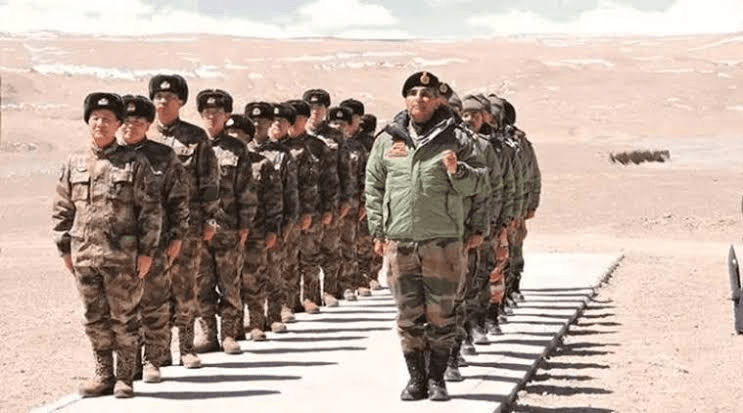
It is the Himalayan boundary dispute that remains most volatile. The Line of Actual Control (LAC) runs for approximately 3,488 kilometres in three sectors i.e. the western, middle and the eastern but in none of them has a legally certified boundary been delineated and militarily recognized by the two armies. The eastern sector dispute over Arunachal Pradesh, which China claims as “South Tibet,” and the western sector standoffs in the Depsang plains and Demchok represent not merely bilateral disagreements but fundamental contests over territorial sovereignty.10 Indian analysts, including Brahma Chellaney, have argued that China’s approach is one of “salami-slicing”: incremental territorial accretion that individually falls below the threshold of armed conflict but cumulatively reshapes ground realities.11
Indo-Pacific Competition
The battle for influence beyond the Himalayas is on. As India and China compete for dominance in the Indo-Pacific, it is interesting to note the direction that New Delhi’s foreign and security policy is taking. India is inching closer to Quad and is busy cobbling together a robust network of security partnerships with like-minded countries, with particular emphasis on those with a navy — France, the UK, and the US, for instance. Given that India is the current chair of Indian Ocean Rim Association, this strategic calculus is also geared towards shaping the rules and norms of the emerging architecture of the Indo-Pacific. For China, the Quad is an entity created to contain it, and the growing proximity between India and Washington is nothing but India’s acceptance of its strategic subordination.12 Professor at the Australian National UniversityRory Medcalf has argued that the Indo-Pacific framing itself represents a strategic choice by India and its partners to contest China’s preferred regional architecture, centred on the Asia-Pacific and ASEAN-centric multilateralism.13
Maritime Rivalry in the Indian Ocean
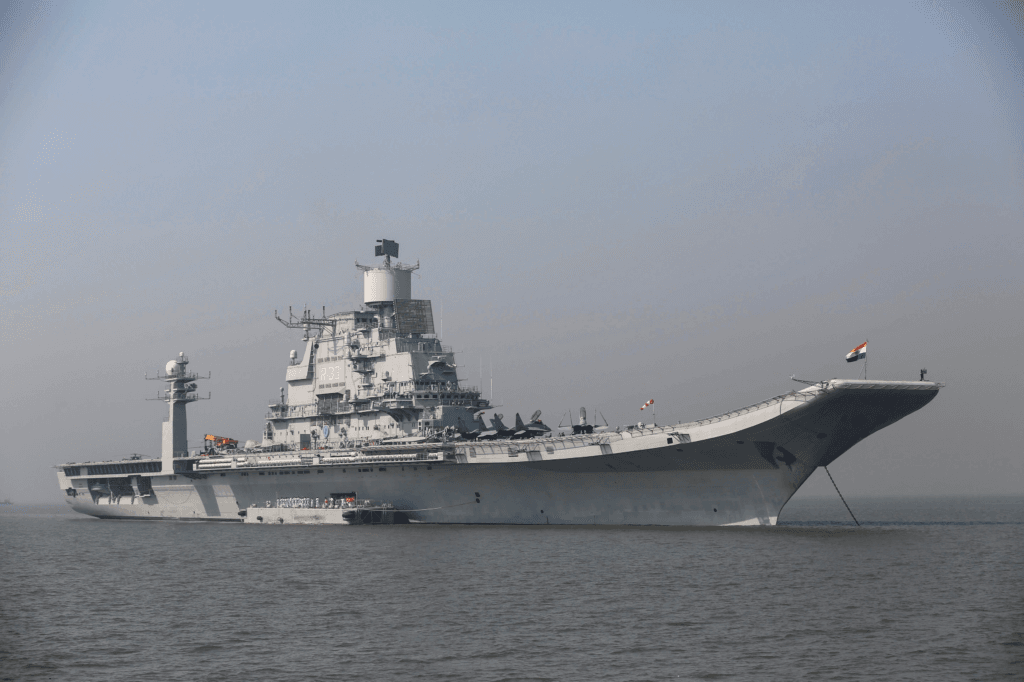
The Indian Ocean is the arena where the structural competition between India and China is perhaps most stark. China’s “String of Pearls” strategy — a network of commercial ports, logistics facilities, and diplomatic relationships stretching from Gwadar in Pakistan through Hambantota in Sri Lanka to Djibouti in the Horn of Africa — has long concerned Indian strategic planners.14 India regards the Indian Ocean as its natural sphere of strategic interest. China’s naval presence in the region, including submarine patrols and the first overseas base at Djibouti, is read in New Delhi as encirclement by another name. The two navies have not yet confronted each other directly, but the logic of their respective postures generates persistent tension.15
Economic Distrust and Supply Chain Vulnerability
India and China are deeply economically interdependent in ways that complicate strategic separation. Bilateral trade exceeded 136 billion dollars in 2023, making China India’s largest trading partner despite the post-Galwan political freeze.16 India runs a structural trade deficit with China, concentrated in electronics, pharmaceuticals, and industrial inputs, that New Delhi views as a strategic vulnerability. Since 2020, India has imposed restrictions on Chinese investment, banned hundreds of Chinese applications, and pursued “China Plus One” industrial policies designed to reduce supply chain dependency. These measures signal strategic intent without delivering economic decoupling, which remains structurally difficult in the medium term.17
Strategic Partnerships and Alliance Dynamics
Perhaps the most structurally significant element of contemporary rivalry is the Sino-Pakistani axis and its relationship to Indian security calculations. China’s all-weather partnership with Pakistan, including the China-Pakistan Economic Corridor (CPEC) and consistent support in multilateral forums, presents India with a two-front strategic challenge.18 India’s response has been to cultivate a parallel network of strategic relationships: the Quad, the I2U2 grouping with Israel, the UAE, and the United States, bilateral defence agreements with France and Australia, and the Supply Chain Resilience Initiative with Japan and Australia. The cumulative logic of these partnerships reinforces China’s perception of encirclement, generating precisely the security dilemma spiral that neorealist theory predicts.19
Why Permanent Hostility Is Unsustainable
The case for avoiding a permanently hostile equilibrium rests on several converging arguments. The first is economic. Despite political tensions, India and China remain bound by trade relationships that neither government can easily sever without imposing significant costs on its own economy. Indian industry depends on Chinese inputs across pharmaceuticals, electronics, and capital equipment. Chinese manufacturers value access to India’s growing consumer market. The decoupling process will take years, and its completion is not guaranteed. Pursuing maximally confrontational policies during that transition risks disrupting economic activity in ways that neither New Delhi nor Beijing can easily absorb.20
The second argument is structural. A sustained hostile equilibrium between India and China would force every other Asian state into an impossible choice between the two largest regional powers. This would fracture ASEAN’s cherished strategic autonomy, destabilise South Asia’s safety, and undermine the multilateral institutions, including the Shanghai Cooperation Organisation (SCO) and the BRICS forum, where India and China are simultaneously members. Graham Allison’s Thucydides Trap framing that states that collision between two superpowers is inevitable despite mutual losses caused by the clash, whatever its analytical limitations, correctly identifies the systemic risks that attend rising-power transitions when managed poorly.21
The third argument concerns global governance. The challenges of climate change, pandemic preparedness, and global financial stability require cooperative frameworks that include both India and China. If the two countries are locked into a structurally hostile relationship, their capacity to contribute to these global governance imperatives is severely constrained. Henry Kissinger’s argument that the great powers of any era bear a special responsibility for maintaining international order is unfashionable in some quarters, but the underlying logic retains its force.22
John Mearsheimer’s offensive realism would predict continued rivalry as the natural condition of a multipolar Asia. But even within a realist framework, Mearsheimer acknowledges that states can and do engage in what he calls “managed competition,” where the risks of escalation are too high and the costs of unconstrained rivalry too prohibitive to sustain indefinitely.23 The nuclear dimension alone imposes a structural imperative for restraint: both India and China are nuclear-armed states, and the risks of miscalculation in a crisis along the LAC, particularly given the absence of robust crisis communication mechanisms, are not trivial.
The Possibility of Functional Strategic Coexistence
Functional strategic coexistence is not a euphemism for normalisation. It does not require the resolution of the territorial dispute, the abandonment of strategic partnerships, or a fundamental change in either country’s strategic ambitions. What it requires is a shared, if unspoken, recognition that the costs of unconstrained competition exceed the benefits, and that certain domains of interaction can be insulated from political friction without compromising either side’s strategic position.24
C. Raja Mohan has described India’s foreign policy challenge as managing “strategic multi-alignment”: maintaining meaningful relationships with the United States and its partners while preserving India’s historic commitment to strategic autonomy and its interest in a genuinely multipolar world order.25 Functional strategic coexistence fits within this framework. It allows India to maintain its defence partnerships and its competitive posture on the LAC while creating selective channels for cooperation on trade, climate, and regional stability. For China, it offers a pathway to prevent India’s full strategic absorption into a US-led security architecture, which Beijing regards as its primary strategic threat in South Asia.
Robert Keohane and Joseph Nye’s theory of complex interdependence is directly relevant here. Where states are bound by multiple overlapping channels of interaction across economic, political, and transnational dimensions, the use of force becomes less attractive and the costs of disruption rise for both parties.26 India and China already exhibit many of these characteristics despite their political tensions. The challenge is to cultivate institutional mechanisms that translate existing interdependence into strategic predictability.
The D.E.A.L. Strategic Choice Matrix
To map the strategic choices available to India and China, this brief introduces an original analytical framework: the D.E.A.L. Strategic Choice Matrix. The framework is grounded in game-theoretic logic and draws on the structure of the Chicken Game to model the payoffs associated with different strategic postures. The four scenarios are:
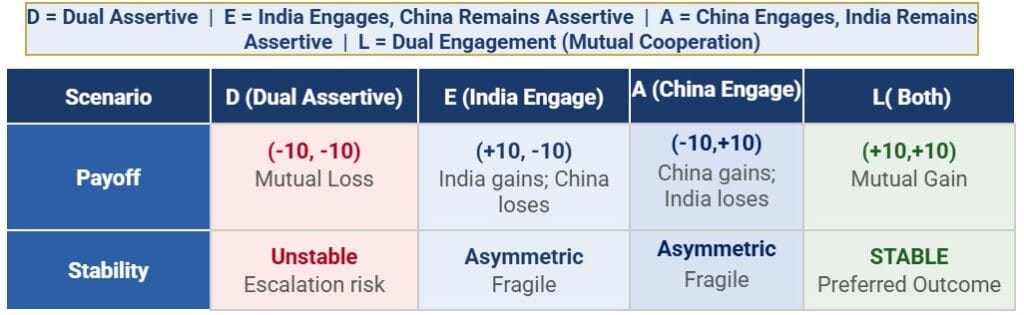
D: Dual Assertive (-10, -10)
The “D” scenario describes the present trajectory. Both India and China pursue assertive postures simultaneously, reinforcing each other’s threat perceptions and generating escalating costs for both parties. On the LAC, both sides deploy additional troops and infrastructure. In the Indo-Pacific, India deepens Quad integration, while China accelerates its Indian Ocean presence. In trade, both governments pursue decoupling strategies that raise costs without delivering strategic clarity.27 The payoff is (-10, -10): both states lose. The structural logic resembles the Chicken Game, in which two drivers speed toward each other and both crash if neither swerve. The tragedy of the Dual Assertive scenario is that neither side intends the worst outcome; each is responding to what it perceives as the other’s provocation. Mistrust traps both states in a dynamic that is individually rational at each decision point but collectively irrational in aggregate. This is the classic security dilemma, articulated by John Herz and later refined by Robert Jervis, playing out at civilisational scale.28
E: India Engages, China Remains Assertive (+10, -10)
In this scenario, India unilaterally extends concessions or diplomatic engagement, while China maintains its assertive posture. The payoff is (+10, -10): India’s act of strategic generosity is not reciprocated, and China exploits the space created by Indian restraint to consolidate tactical advantages. From India’s perspective, this is the scenario to be avoided at all costs. Historical memories of 1962, when India’s “forward policy” was met with decisive Chinese force, make New Delhi deeply allergic to any posture that might be interpreted as unilateral accommodation.29
The asymmetric payoff in the “E” scenario reflects not moral judgment but strategic logic. The engaging party absorbs costs, while the assertive party captures benefits. No Indian government could sustain this domestically, and it is therefore not a durable equilibrium.
A: China Engages, India Remains Assertive (-10, +10)
The “A” scenario is the mirror image: China extends diplomatic or economic engagement, while India maintains its assertive posture. This might occur if Beijing calculates that the costs of continued confrontation, including India’s accelerating alignment with Washington, outweigh the benefits of maintaining pressure on New Delhi. The payoff (-10, +10) advantages China diplomatically, while India’s defensive posture imposes its own costs. This scenario is also unstable: China’s domestic politics and Xi Jinping’s nationalist consolidation make strategic retreat politically difficult, and Indian public opinion, sensitised by Galwan, would be suspicious of any Chinese overture that appeared designed to weaken India’s defensive partnerships.30
L: Dual Engagement (+10, +10) — The Preferred Equilibrium
The “L” scenario represents Dual Engagement: both states simultaneously pursue selective cooperation while maintaining competitive postures in contested domains. The payoff is (+10, +10). This is not bilateral friendship: it is managed competition with guardrails. Both states retain their strategic partnerships, their territorial positions, and their competitive ambitions. What changes is the addition of institutional mechanisms: crisis hotlines, military confidence-building measures, maritime dialogue frameworks, and economic risk management protocols that reduce the probability of accidental escalation and create channels for selective cooperation.31
The “L” scenario is the most stable long-term outcome for several reasons. First, it delivers positive payoffs for both parties, removing the incentive for unilateral defection. Second, it creates institutional investments that raise the cost of returning to the “D” equilibrium. Third, it is consistent with the domestic political constraints of both governments: neither Xi Jinping nor any Indian Prime Minister can be seen to have surrendered strategically, but both can present managed engagement as diplomatic maturity. The analysis of David Shambaugh, American political scientist, sinologist, and policy advisor, Chinese foreign policy behaviour suggests that Beijing is capable of sophisticated tactical accommodation when the strategic costs of confrontation become prohibitive.32
Implications for the Indo-Pacific Security Architecture
The D.E.A.L. framework has direct implications beyond the bilateral relationship. An India-China dynamic locked in the “D” scenario generates third-party pressures across South Asia, Southeast Asia, and the Indian Ocean region. Smaller states are forced to choose sides, undermining the strategic autonomy that most of them prize. ASEAN centrality, the principle that ASEAN-led multilateral forums should remain the primary vehicle for regional security dialogue, is eroded when the region’s two largest powers are in sustained confrontation.33
Conversely, an India-China relationship operating in the “L” scenario creates strategic space for Asian multilateralism. The Shanghai Cooperation Organisation, the East Asia Summit, and BRICS all function more effectively when India and China are pursuing managed engagement rather than using these forums as arenas for proxy competition. The “L” outcome is therefore not merely a bilateral preference but a structural requirement for stable Asian order.
Also Read: Between Principle and Pressure: India’s Strategic Autonomy in the age of G2 Competition and Tariff Diplomacy
Policy Recommendations
Moving from the “D” equilibrium to the “L” equilibrium requires deliberate policy action from both governments. The following recommendations are addressed to policymakers in New Delhi and Beijing, as well as to the regional and multilateral institutions that have a stake in Asian stability.
1. Establish a Direct Crisis Communication Mechanism
The most urgent priority is the creation of a functional hotline between the Indian and Chinese military commands along the LAC, with a parallel diplomatic channel at the foreign secretary level. The existing Flag Meeting mechanism has proven inadequate for managing crisis communication during fast-moving confrontations. A dedicated crisis hotline, modelled on the US-Soviet hotline established after the Cuban Missile Crisis of 1962, would reduce the risk of miscalculation and signal mutual commitment to conflict prevention.34
2. Implement Military Confidence-Building Measures
India and China should negotiate a new generation of military confidence-building measures beyond the 1993 and 1996 border agreements. These should include: advance notification requirements for military exercises within a defined proximity of the LAC; limits on the deployment of new weapons systems to forward areas; and a commitment to prior notification of infrastructure construction that could alter the tactical balance. Such measures do not require the resolution of the territorial dispute — they require only a shared interest in preventing accidents.35
3. Establish a Maritime Dialogue Framework
The Indian Ocean requires a dedicated bilateral maritime dialogue framework to manage the growing proximity of Indian and Chinese naval operations. This could be modelled on the incidents-at-sea agreements that the United States and Soviet Union developed during the Cold War. A bilateral maritime protocol would not constrain either navy’s operational freedom but would establish communication norms that reduce the risk of inadvertent escalation at sea.36
4. Create an Economic Risk Management Architecture
Both governments should establish joint mechanisms for managing economic interdependence risk. This does not mean abandoning decoupling strategies, which are legitimate exercises of economic sovereignty, but rather creating institutional frameworks for managing the transition. A bilateral trade review mechanism, empowered to address grievances and monitor supply chain risks, would provide a structured channel for economic dialogue that is currently absent.37
5. Pursue Selective Institutional Cooperation
India and China should identify two or three domains of shared interest where selective cooperation is politically sustainable. Climate finance mechanisms, pandemic preparedness coordination through the WHO, and disaster response cooperation in the Indian Ocean region are candidates. These do not require strategic alignment — they require only the recognition that shared functional interests exist that can be addressed without compromising competitive postures elsewhere.38
6. Engage Regional Multilateral Mechanisms
Both governments should commit to using ASEAN-led forums, including the East Asia Summit and the ASEAN Regional Forum, as venues for bilateral confidence-building rather than as arenas for proxy competition. This means agreeing in advance not to use these forums to table unilateral accusations or resolutions that would force other members to take sides. The principle of ASEAN centrality is worth preserving for structural reasons: it provides a neutral architecture for dialogue that neither India nor China could independently provide.39
7. Calibrate Competition Rather Than Escalate
Both governments should adopt internal doctrinal guidelines on “calibrated competition”: the principle that competitive actions should be proportionate, reversible where possible, and designed to establish strategic deterrence rather than to inflict escalatory costs. This is not a call for strategic restraint as such; it is a call for strategic discipline. Escalation carries asymmetric risks in a nuclear environment, and both governments have domestic political incentives to manage public expectations about what bilateral competition can deliver.40
Conclusion
The question posed in the title of this brief, whether India and China can build a functional strategic coexistence, does not admit a comfortable answer. The structural conditions of their relationship, a contested border, competing visions of Asian order, asymmetric economic interdependence, and deepening third-party alliance entanglements, generate persistent competitive pressures that no diplomatic formula can dissolve. Analysts who predict inevitable confrontation are not wrong about the structural forces at work. They are simply underestimating the costs that both governments would incur from acting on those structural pressures without restraint.
The D.E.A.L. Strategic Choice Matrix demonstrates that the “D” outcome, Dual Assertive, is a trap rather than a strategy. Both states lose in the aggregate even as each individual decision that contributes to it may appear rationally defensible in isolation. Escaping the trap requires not goodwill, which is in short supply, but enlightened self-interest, which both states possess in sufficient measure if their leaderships choose to apply it.41
Asia’s future stability does not depend on India and China becoming friends. It depends on them becoming predictable adversaries, governed by institutionalised restraint, capable of selective cooperation, and willing to manage their competition through channels that reduce the risk of catastrophic miscalculation. Functional strategic coexistence is not an ideal outcome. It is the least bad option available, and that, in geopolitics, is usually the best that responsible statesmanship can deliver.
The choice between the “D” equilibrium and the “L” equilibrium will be made not in academic seminars but in the decisions of Indian and Chinese leaders about infrastructure deployments along the LAC, naval patrol patterns in the Indian Ocean, and diplomatic postures in multilateral forums. The D.E.A.L. framework suggests that the structural logic of the situation, if properly understood, points toward managed engagement as the rational choice. The task of policy is to make that logic legible to decision-makers before the costs of the alternative become irreversible.42
Credits

Dr. Subham Tripathy
Lecturer in Political Science, Government Women’s College, Bhawanipatna, Kalahandi, Odisha, India

Polina Digo
Associate Editor, Hegemoniq
The views and opinions expressed in this policy brief are those of the author and do not necessarily reflect the official policy or position of Hegemoniq.
- Srinath Raghavan, “The Galwan Valley Clashes and the Future of India-China Relations,” Carnegie India Working Paper, July 2020. See also Shivshankar Menon, India and Asian Geopolitics: The Past, Present (Washington, DC: Brookings Institution Press, 2021), 211-235.
↩︎ - Rory Medcalf, Indo-Pacific Empire: China, America and the Contest for the World’s Pivotal Region (Manchester: Manchester University Press, 2020), 87-112. ↩︎
- Tanvi Madan, “The Border Disengagement and What Comes Next,” Brookings India, November 2024. ↩︎
- C. Raja Mohan, “India’s Strategic Coexistence Imperative,” Foreign Affairs, March/April 2023. The term “functional strategic coexistence” is used in this brief to describe a condition of managed competition rather than alliance or normalisation. ↩︎
- John W. Garver, Protracted Contest: Sino-Indian Rivalry in the Twentieth Century (Seattle: University of Washington Press, 2001), 1-45. ↩︎
- David Shambaugh, China Goes Global: The Partial Power (Oxford: Oxford University Press, 2013), 67-98. See also Rush Doshi, The Long Game: China’s Grand Strategy to Displace American Order (Oxford: Oxford University Press, 2021). ↩︎
- Brahma Chellaney, “Doklam: The Strategic Significance,” Project Syndicate, August 2017. ↩︎
- Menon, India and Asian Geopolitics, 178-195. ↩︎
- Tanvi Madan, Fateful Triangle: How China Shaped US-India Relations during the Cold War (Washington, DC: Brookings Institution Press, 2020), 288-302. ↩︎
- Manoj Joshi, “Understanding the India-China Border: The Basis for the Galwan Valley Crisis,” Observer Research Foundation Occasional Paper No. 256, July 2020. ↩︎
- Brahma Chellaney, Water, Peace, and War: Confronting the Global Water Crisis (Lanham, MD: Rowman and Littlefield, 2013). See also Chellaney, “China’s Salami-Slice Strategy,” Japan Times, July 25, 2013. ↩︎
- Rory Medcalf, “The Quad: Its Past, Present and Future,” Lowy Institute Analysis, December 2021. ↩︎
- Medcalf, Indo-Pacific Empire, 134-160. ↩︎
- James Holmes and Toshi Yoshihara, “China’s Naval Ambitions in the Indian Ocean,” Journal of Strategic Studies 31, no. 3 (2008): 517-549. ↩︎
- Iskander Rehman, “Drowning Stability: The Perils of China’s Undersea Nuclear Deterrent,” Naval War College Review 65, no. 2 (2012): 64-88. ↩︎
- Ministry of Commerce and Industry, Government of India, Annual Report on Foreign Trade Statistics, 2023-2024 (New Delhi: DGCI&S, 2024). ↩︎
- Rajeswari Pillai Rajagopalan, “India’s China Plus One Strategy: Progress and Limitations,” ORF Economic Policy Brief, August 2023. ↩︎
- Bruce Riedel, Deadly Embrace: Pakistan, America and the Future of the Global Jihad (Washington, DC: Brookings Institution Press, 2011), 112-134. ↩︎
- Robert Jervis, Perception and Misperception in International Politics (Princeton: Princeton University Press, 1976), 58-113. The security dilemma logic is applied to the India-China-US triangle in Ashley Tellis, Striking Asymmetries: Nuclear Transitions in Southern Asia (Washington, DC: Carnegie Endowment for International Peace, 2022). ↩︎
- Subramanian Swamy, India-China Relations: Trajectory, Problems and Prospects (New Delhi: Centre for Policy Research, 2022). ↩︎
- Graham Allison, Destined for War: Can America and China Escape Thucydides’s Trap? (New York: Houghton Mifflin Harcourt, 2017), 39-72. ↩︎
- Henry Kissinger, World Order (New York: Penguin Press, 2014), 228-275. ↩︎
- John J. Mearsheimer, The Tragedy of Great Power Politics, updated ed. (New York: W.W. Norton, 2014), 338-411. ↩︎
- This framing draws on the concept of “competitive coexistence” developed in the Cold War context by Raymond Aron, Peace and War: A Theory of International Relations (London: Weidenfeld and Nicolson, 1966), and adapted here for the contemporary Asian context. ↩︎
- C. Raja Mohan, Samudra Manthan: Sino-Indian Rivalry in the Indo-Pacific (Washington, DC: Carnegie Endowment for International Peace, 2012), 201-225. ↩︎
- Robert O. Keohane and Joseph S. Nye, Power and Interdependence, 4th ed. (Boston: Longman, 2011), 19-37. ↩︎
- Dhruva Jaishankar, “The India-China Military Standoff: What Comes Next?,” Brookings India, June 2020. ↩︎
- Robert Jervis, “Cooperation Under the Security Dilemma,” World Politics 30, no. 2 (1978): 167-214. See also John Herz, Political Realism and Political Idealism (Chicago: University of Chicago Press, 1951). ↩︎
- Neville Maxwell, India’s China War (New York: Pantheon Books, 1970). The 1962 war and its interpretive legacy continue to shape Indian strategic culture; see Srinath Raghavan, War and Peace in Modern India (Basingstoke: Palgrave Macmillan, 2010), 290-330. ↩︎
- Minxin Pei, China’s Trapped Transition: The Limits of Developmental Autocracy (Cambridge: Harvard University Press, 2006). On Xi’s nationalist consolidation, see Elizabeth Economy, The World According to China (Cambridge: Polity Press, 2021). ↩︎
- The concept of managed competition as a bilateral framework is explored in Ashley Tellis, “Hustling in the Himalayas: The Sino-Indian Border Confrontation,” Carnegie Endowment for International Peace, June 2020. ↩︎
- David Shambaugh, China and the World (Oxford: Oxford University Press, 2020), 28-66. ↩︎
- Bilahari Kausikan, Dealing with an Ambiguous World (Singapore: World Scientific, 2017). On ASEAN centrality, see Amitav Acharya, The Making of Southeast Asia: International Relations of a Region (Singapore: Institute of Southeast Asian Studies, 2012). ↩︎
- Happymon Jacob, Line on Fire: Ceasefire Violations and India-Pakistan Escalation Dynamics (Oxford: Oxford University Press, 2019). The hotline analogy is drawn from McGeorge Bundy et al., “The President’s Choice: Star Wars or Arms Control,” Foreign Affairs 63, no. 2 (1984): 264-278. ↩︎
- P.K. Singh, “Revising India-China Border Agreements,” IDSA Monograph Series, April 2021. ↩︎
- Sean Mirski, “Stranglehold: The Context, Conduct and Consequences of an American Naval Blockade of China,” Journal of Strategic Studies 36, no. 3 (2013): 385-421. On incidents-at-sea agreements, see David Winkler, Incidents at Sea: American Confrontation and Cooperation with Russia and China (Annapolis: Naval Institute Press, 2017). ↩︎
- Saon Ray and Smita Miglani, “Restructuring India’s Trade Relations with China: Opportunities and Challenges,” Indian Council for Research on International Economic Relations Working Paper 407, September 2021. ↩︎
- Nirupama Rao, The Fractured Himalaya: India Tibet China 1949-62 (New Delhi: Penguin Viking, 2021). On climate cooperation, see Alex Wang, “China’s Climate Commitments and International Cooperation,” UCLA School of Law Research Paper, 2022. ↩︎
- Kishore Mahbubani and Jeffery Sng, The ASEAN Miracle: A Catalyst for Peace (Singapore: NUS Press, 2017). ↩︎
- This concept draws on the classical deterrence literature, particularly Glenn Snyder, Deterrence and Defense: Toward a Theory of National Security (Princeton: Princeton University Press, 1961). ↩︎
- The notion of “enlightened self-interest” as a basis for strategic cooperation in competitive relationships is developed in Robert Axelrod, The Evolution of Cooperation (New York: Basic Books, 1984). ↩︎
- Menon, India and Asian Geopolitics, 290-310. ↩︎