

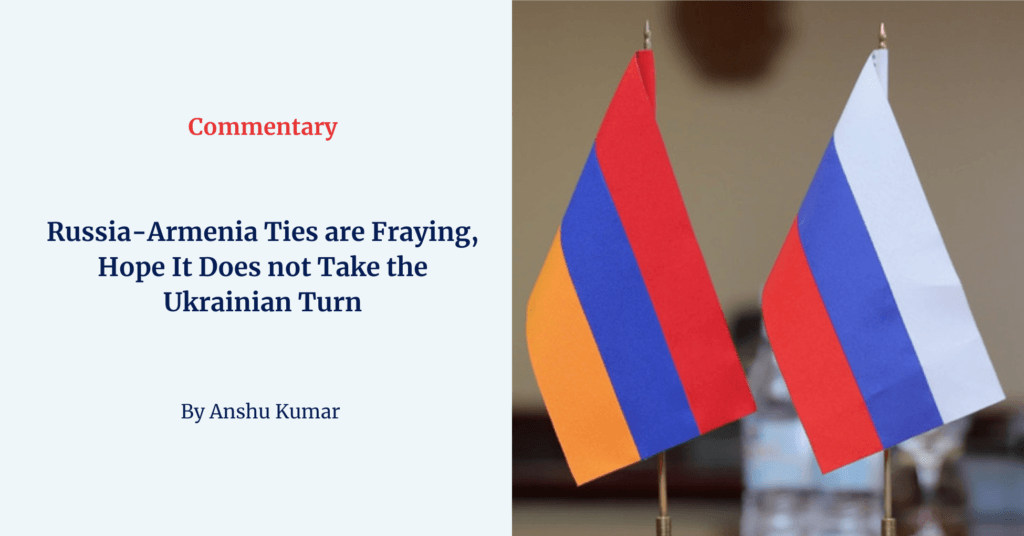
Souring Russia-Armenia Ties
Recently, Russian Foreign Ministry Spokeswoman Maria Zakharova warned that Russia is prepared to unilaterally suspend the 2013 agreement, which guaranteed Armenia a duty-free supply of natural gas, petroleum products, and rough diamonds, over Armenia’s growing ties with the European Union (EU). In response, Armenian Prime Minister Nikol Pashinyan argued that it is “illogical to frighten Armenia with high prices” and the EU membership would bring Armenia “so much more money that things won’t actually seem expensive.” This is not an isolated event. Moscow’s ties with Yerevan have been fraying for years now. Concerted statements of displeasure by Russia, notably by the Russian Security Council Secretary Sergei Shoigu, Russian foreign policy adviser Yury Ushakov, Deputy Foreign Minister Mikhail Galuzin, and Russian President Vladimir Putin, reveal deepening fissures between the two countries.
Last month (May), Russia imposed a temporary restriction on all flower imports from or transiting through Armenia. Putin even warned that it would be “impossible by definition” for Armenia to remain part of both the EU and the Russia-led Eurasian Economic Union (EAEU). Russia also planned to impose temporary restrictions on Armenian berries and fresh vegetables starting May 30, 2026. Things got worse when the Kremlin, last month, “scolded” Yerevan for hosting Ukrainian President Volodymyr Zelensky for a European summit. Zakharova also condemned the joint declaration at the summit, which recognised Yerevan’s aspiration to deepen economic and security cooperation with the EU. Later, Pashinyan told reporters, “Back in 2022-2023 I already stated that, on the issue of Ukraine, we are not an ally of Russia.” Subsequently, at the EAEU Summit (28-29 May 2026), which Pashinyan skipped due to his “election campaign,” Putin tried his best to dissuade Armenia from leaving the EAEU for the EU. His statements reflected a carrot-and-stick approach.
Back in the Past
This sense of urgency on the Russian side follows Armenia’s adoption of a bill on 26 March 2025 to seek EU membership. However, things go back much further. The first rupture was witnessed in 2020, when Azerbaijan launched a large-scale offensive to capture the Nagorno-Karabakh enclave that has remained disputed since the 1990s. After 44 days of fighting, Russia brokered a ceasefire and deployed peacekeeping forces. But the outcome was a humiliating territorial loss for Armenia. The latter was unhappy with Russia’s unwillingness to come to its rescue, despite Armenia’s membership of the Collective Security Treaty Organisation (CSTO). The ceasefire was not very effective, with over the next two years, Azerbaijani forces launching subsequent incursions into undisputed Armenian territory. The already withering trust in Russian security took a blow in September 2023, when, in a 24-hour military operation, Azerbaijan seized the entirety of Nagorno-Karabakh while Russian peacekeepers remained nonchalant. Consequently, in 2024, Armenia froze its participation in the CSTO. For years now, Yerevan has been seeking partners in India, the US, and European countries to ensure its security. In 2025, the US and Armenia held Eagle Partner 2025, a joint military exercise. Recently, France and Armenia signed a joint declaration establishing a strategic partnership and agreed to cooperate in defence, finance, cybersecurity, infrastructure, and education fields.
The June 7 Elections
While accepting that it is impossible to be a member of both the EU and the EAEU, Armenian Foreign Minister Ararat Mirzoyan said, “We will continue our path toward the EU.” However, the 2025 official declaration to join the EU would not automatically grant Armenia membership. A referendum by the people of Armenia would decide whether Yerevan would chart a Euro-Atlantic path. Moreover, the June 7 parliamentary election in Armenia pits opposition against Pashinyan’s Civil Contract party, with Strong Armenia, Armenia Alliance, Prosperous Armenia, and other parties opposing it. The Strong Armenia party, led by Russian-Armenian billionaire Samvel Karapetyan, leans toward restoring ties with Russia, though he presents himself as a pragmatist rather than an ideologue. He offers a third way between Pashniyan’s Civil Contract and Robert Kocharyan’s Armenia Alliance. He seeks to balance between Russia and the West. Armenia Alliance, while drawing support from conservative voters and rural constituencies, is the most explicitly pro-Russian party, prioritising state security above all else. Prosperous Armenia is led by a billionaire businessman, Gagik Tsarukyan. This party is sceptical of Pashinyan’s Western pivot. It draws support from patronage networks and business interests. While not as explicitly pro-Moscow as the Armenia Alliance, this party is comfortable with the old Russian-dependent order.
The opposition party in Armenia is largely fragmented and faces several constraints. Kocharyan and Sargsyan, both former presidents, face reputational constraints by registering low levels of public trust. Despite the current president’s public support diminishing, polls suggest Civil Contract is likely to remain the largest party. However, the current government’s ability to secure a majority in the elections is in doubt. In particular, Pashniyan’s peace efforts with Azerbaijan, mediated by the US in 2025, remain an uncomfortable topic for the public, with 44 per cent supporting and 41 per cent opposing. This peace process requires Armenia to amend its constitution to remove what Azerbaijan considers territorial claims against it. This creates a “paradox,” in which the current ruling party may emerge as the largest party after elections due to a fragmented, weak opposition. A 2024 survey found that around 66 per cent of Armenians view Russia negatively, up from 49 per cent in March 2023. Based on this survey, it would be domestically costly for political parties to pursue closer strategic ties with Russia. If Pashinyan secures a majority, we can expect strategic distancing from Moscow, EU integration efforts, and a compromise with Azerbaijan. These goals can get diluted or compromised if the current government enters a coalition.
Russian Concerns
Russia, nevertheless, prepares for the worst. Countries that join the EU not only share a free trade area but also laws and judicial bodies. These states partially surrender their sovereignty to the supranational body, and can also have defence cooperation and military assistance frameworks. It is no wonder that Shoigu pointed to Yerevan’s undertaking of a series of measures that were “definitively unfriendly towards Russia,” be it the decision to join the International Criminal Court, to extradite Russian citizens to third countries, or “to make things harder for Russian economic entities.” Putin also warned Armenia by drawing a parallel with the Ukraine war, which he claimed began with attempts to join the EU. While the Russian 102nd military base is still stationed in Gyumri, with about 4,000 Russian troops remaining in the country, Russian strategic thinking takes into account the “near abroad”—the former Soviet space essential to Russia’s overall security — that should not fall under the North Atlantic Treaty Organisation (NATO)’s controlinfluence. A Russian expert sees Armenia’s EU membership as likely to be followed by NATO membership, which could lead to the establishment of military bases or surveillance infrastructure in Armenia.
Also Read: India in the Arctic: Addressing Climate Vulnerability and Energy Ambitions
New Reality
Both sides still seek to manage this changing relationship with reassurances. The relationship is not dead; what has changed is its fundamental nature. Armenia no longer believes in a patron-client or protector-protected relationship. With Russia’s ability to be a security provider eroded in Armenia’s mind, the latter seeks a more independent course. It now focuses on expanding the domestic defence industry, which has already booked $460 million in military orders over the last three years, according to Pashinyan. This transformation is not driven by ideology or preferences for democracy over authoritarianism, but by the lived experience of Armenian insecurity and the lesson, written in the displacement of thousands of Armenians from Karabakh, that alliances which do not deliver protection are no alliances.