

When Giants Clash: The Costs of US-China Rivalry
The Indo-Pacific region is facing a challenging period amid strategic competition between the United States (US) and China, both seeking to strengthen their influence through various geopolitical policies. China is showing more assertive regional behaviours, such as building 20 artificial islands as outposts in the Paracel Islands; harassing Philippine fishing vessels in its exclusive economic zone; and raising tensions over Taiwan. In response, the US forged an alliance network in the region, such as the 2021 AUKUS agreement, enabling Australia to acquire nuclear-powered submarines with longer range and greater stealth.
Other nations, including Japan, South Korea, and the Philippines, increasingly view the US as their primary security partner due to the perceived threat from China. Meanwhile, Russia acts as China’s strategic enabler, and North Korea remains a disruptive variable with high potential for escalation. For smaller countries in the region, this competition creates a less predictable situation, as regional stability is sustained only by a volatile environment and short-term cost-benefit calculations. Therefore, the region is at risk of being fragmented into competing blocs, and the emergence of a credible alternative security provider is essential.
Strategic Autonomy Through Diversification: The ASEAN-EU Alternative
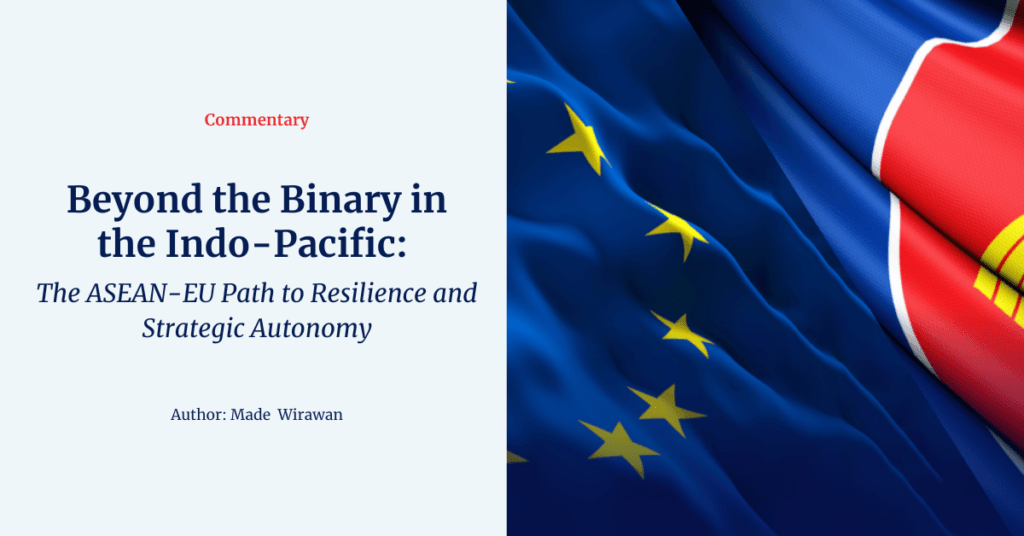
Amid regional uncertainty, the ASEAN-EU Strategic Partnership, elevated in 2020, provides an alternative framework for cooperation. This partnership converges two strategic visions: the EU Strategy for Cooperation in the Indo-Pacific (2021) and the ASEAN Outlook on the Indo-Pacific (2019). Both documents acknowledge ASEAN’s central role in promoting multilateral cooperation, realising a rules-based order, and peaceful resolution of disputes. However, ASEAN’s mechanisms, known as the “ASEAN Way,” require a nuanced understanding. This diplomatic model, which emphasises the fundamental principles of sovereignty, consensus, and peaceful conflict resolution, has a unique capacity to bridge the interests of great powers without falling into zero-sum logic. Instead, emphasising these principles could also compromise the association’s decisiveness.
This is where the concept of strategic autonomy becomes equally vital for Indo-Pacific states seeking agency. It is broadly defined as the ability to act independently to protect its strategic interests and build its own capabilities and resilience beyond defense, including trade policy, energy policy, and the cyber domain. In the Indo-Pacific context, autonomy must demonstrate a country’s capacity to diversify its partnerships and defend its national interests amidst great power competition. This soft architecture strengthens regional resilience through diversification. If a country is less dependent on a single great power for essential needs, such as electricity, digital infrastructure, or health security, it is less susceptible to coercion. Therefore, security is also related to reducing unwanted influence by offering a path through pluralism and collective stability.
The ASEAN-EU Strategic Partnership Action Plan (2023-2027) focuses on non-traditional security issues, including digital governance, the green transition, and health security. In the digital realm, for example, member states are striving to enhance technical capabilities and standardise technological infrastructure. While it is difficult to empirically claim complete independence from US or Chinese supply chain dominance, this collaboration aims to diversify options and reduce excessive dependence on a few dominant powers. By promoting issue-based collaboration, the partnership aims to build resilience to supply chain disruptions, rather than militarising the relationship.
Institutionalising an open, rule-based architecture allows countries to have more say in determining their own future. Strengthening platforms like the Asia-Europe Meeting (ASEM) and the ASEAN Regional Forum (ARF) bring together major powers, including the US, China, and the EU, to build confidence through preventive dialogue. A strategy of “open regionalism,” open to various outside powers, is likely to prevent any single country from becoming dominant. Involving many countries within a single framework also promotes understanding by enabling the voices of less powerful countries to be heard, leading to more substantive confidence-building measures.
Explore: Tracking BRICS 2026: A Hegemoniq Initiative
Toward a Multiplex Future
The ASEAN-EU Strategic Partnership illustrates how middle and smaller powers can navigate great power competition through strategic diversification and establishes an alternative approach towards a non-hegemonic system. Keeping this multilateralism alive will enable different powers to coexist in a dynamic and open environment. As Amitav Acharya argues in his theoretical framework, multilateralism creates conditions for a “multiplex world,” a future where multiple actors and orders coexist, providing choices not only between Washington and Beijing but also for a genuinely independent regional future.
For policymakers, potential measures could include issue-based collaboration where ASEAN and EU interests align. It may help to build on interdependence and diverse roles to avoid a binary choice. However, it is important to acknowledge that this alternative does not replace conventional security guarantees, but rather complements long-term resilience that can be chosen to reduce incentives for coercion from the outset.