

The current West Asian crisis did not trigger the kind of economic shock many had feared. Despite concerns over energy markets, maritime trade routes, and regional instability, India remained largely insulated from the worst effects. Yet this relative resilience should not obscure from a deeper reality. The crisis highlighted several structural vulnerabilities, which continue to shape India’s economic and strategic exposure, and could become significantly more consequential during a larger, prolonged disruption or involve multiple chokepoints simultaneously.
As India pursues its “Viksit Bharat” ambitions (“Viksit Bharat 2047”, meaning “Developed India”, is Indian state’s long-term vision to transform the country into a developed and prosperous nation by 2047 (Viksit Bharat 2047) marking the 100th anniversary of its independence), the real challenge is not merely sustaining growth, but preserve it amid disruptions. Three structural vulnerabilities constrain that objective: hydrocarbon dependence, exposure to maritime chokepoints, and limited state capacity to anticipate and manage systemic impediments.
Hydrocarbon Dependency
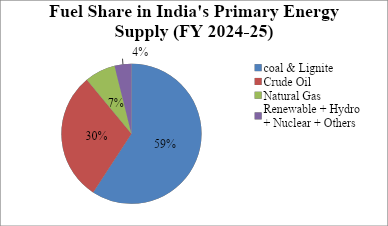
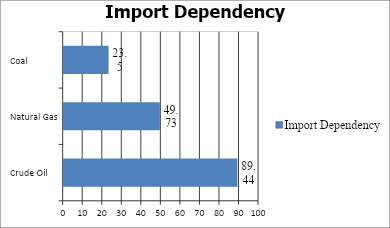
Hydrocarbon imports constitute a significant share of India’s import bill. This dependence makes India’s energy system vulnerable to external supply disruptions. Hydrocarbons account for 36.9% of India’s primary energy supply, as shown in Figure 1 (MoSPI 2026). More importantly, this segment is approximately 82% import-dependent, driven by 89.4% imports dependence for crude oil and 49.73% in Natural Gas as highlighted in Figure 2. The vulnerability is compounded by the geographic concentration of these imports in the chronically unstable West Asian region. India sources roughly 50% of its total crude oil imports and 60% of its total LNG imports from West Asia.
This illustrates a broader geoeconomic reality: geopolitical instability in producer regions is rapidly transmitted into India’s domestic economy through energy markets.
Hydrocarbons remain an essential input across transport, industry, fertilisers, petrochemicals, and manufacturing. Therefore, disruptions in hydrocarbon imports quickly spill over into entire industrial and logistics sectors, underpinning India’s industrial production, logistics, and economic competitiveness. Thus, prolonged disruptions in hydrocarbon supplies can weaken manufacturing, raise logistics costs, fuel inflation, and ultimately slow the pace of India’s development trajectory.
If lack of hydrocarbon represents vulnerability in resources, maritime chokepoints expose India’s dependence on the routes through which those resources flow.
Exposure to Maritime Chokepoints
India is heavily exposed to maritime chokepoints for its imports. This is because India is a maritime trading nation whose energy imports and merchandise trade depend heavily on sea routes. Maritime chokepoints are narrow sea passages through which a disproportionately large volume of global trade and energy flows. Their geographic characteristics make them particularly susceptible to disruption during conflicts, military escalation, or attacks on commercial shipping. For instance, the Strait of Hormuz is a 40 km wide waterway through which around 25% of the world’s seaborne oil trade transits (IEA n.d.). Even limited disruptions can force rerouting, increase insurance premiums, freight costs, delivery times, and input costs, reducing industrial competitiveness and placing upward pressure on inflation. To be more precise, 16% of India’s total external trade navigates through the Hormuz corridor (majorly hydrocarbon imports); approximately 35% of the nation’s total international trade is tied to the Suez Canal and Bab-el Mandeb. Unlike hydrocarbon dependence, exposure to maritime chokepoints is an externally derived structural vulnerability over which India has limited direct control. Therefore, while India’s exposure cannot be eliminated, its economic consequences can be substantially mitigated through greater resilience. Yet, even external resilience is insufficient, if domestic institutions cannot effectively convert strategic opportunities into economic outcomes.
Limitations in State Capacity
India’s diplomatic successes have expanded strategic opportunities – from attracting investments to securing international partnerships. However, converting these opportunities into sustained economic gains depends ultimately on state capacity. State capacity refers to the ability of institutions to coordinate policies, execute projects, respond to crises, and adapt to changing global realities. Strategic announcements alone do not generate geoeconomic leverage; they should be matched with effective implementation and institutional execution. For instance, India lost nearly 300 GWh of renewable electricity in the first quarter of 2026 because transmission infrastructure could not keep pace (Ember Energy 2026). Delays in grid connectivity prevent renewable generation from reaching consumers efficiently, reducing returns on public investment, and slowing the economic benefits expected from India’s energy transition.
Additionally, the institutional coordination challenge hinders infrastructure development. The creation of mechanisms such as PRAGATI in 2015 (Pro-Active Governance and Timely Implementation) reflects an important institutional response to longstanding coordination and implementation challenges (PIB 2026). However, the effectiveness of such initiatives will ultimately depend on whether improvements become systemic rather than remaining confined to flagship monitoring platforms.
Furthermore, New Delhi is accelerating the development of strategic petroleum reserve (SPR) assets, increasing its holding capacity from 5.33MMT to 6.53MMT (PIB: Ministry of Petroleum & Natural Gas 2026). Moreover, India is also exploring global opportunities of storage facilities: recently it signed an agreement with the UAE to explore the potential to store crude at UAE’s eastern oil hub, Fujairah (S&P Global 2026). The initiative to expand SPR represents an important step towards resilience. Their effectiveness, however, depends on institutionalising such investments as a long-term strategic capability rather than accelerating them only after major geopolitical disruptions.
India is strengthening state capacity, but the long-term challenge lies in institutionalising execution across the entire governance system. These vulnerabilities cannot be addressed in silos. They are deeply connected and collectively shape India’s geoeconomic resilience. Preferring one over the other will merely shift the vulnerability rather than reducing it. Therefore, India’s response must be integrated rather than sector-specific.
Building Resilience for “Viksit Bharat”
India’s ongoing efforts — from supplier diversification and expanding strategic petroleum reserves to pursuing IMEC (India-Middle East-Europe-Economic Corridor) and overseas strategic assets — represent important steps towards reducing external vulnerabilities. However, these initiatives should be viewed as complementary components of a broader resilience strategy rather than isolated policy measures. Each forms a pillar of a broader resilience strategy and not the end goal in themselves.
IMEC, in this regard, must not be pushed merely as a trade corridor, but as a long-term geoeconomic resilience project. India should build and own strategic assets abroad – from upstream oil and gas assets, LNG terminals, overseas storage, ports, and logistic hubs to strengthen resilience against geoeconomic headwinds. Institutionalising periodic stress-testing of India’s import basket and strategic supply chains against multi-scenario disruptions rather than assuming current diversification is sufficient.
More significantly, external resilience is sustainable, only when matched with institutional resilience. Even the best-designed resilience strategies are only effective when institutions are responsible for implementing them. The government should streamline the entire chain – from project planning and efficient implementation to effective monitoring with outcome based assessment for more promising results.
India should prepare not merely for isolated disruptions but for compound geopolitical shocks, where energy, trade, logistics, finance, and technology may simultaneously come under stress.
The objective of “Viksit Bharat” should not be to eliminate every external vulnerability—an impossible task in an increasingly fragmented world. Rather, it should be to build an economy capable of sustaining growth despite geopolitical disruptions. In this sense, geoeconomic statecraft is no longer about creating economic interdependence alone, but about building resilience against geopolitical uncertainty.
About the Author

The views and opinions expressed in this op-ed are those of the author and do not necessarily reflect the official policy or position of Hegemoniq.