
Executive Summary
The UAE-South Korea Defence Partnership: Localisation, Supply-Chain Control, and the Search for Autonomy
The UAE has invested heavily in advanced air-defence systems, but sophisticated imported weapons do not automatically provide strategic independence. Their effectiveness can depend on continued access to foreign-made missiles, spare parts, maintenance, software, and technical support.
The UAE’s combat use of South Korea’s Cheongung-II in 2026 has brought this tension into sharper focus. As the US-Iran conflict intensified, the UAE deployed military aircraft to South Korea to expedite the delivery of additional Cheongung systems. At the same time, UAE–South Korea defence cooperation has expanded beyond procurement towards research, development, maintenance, manufacturing, and supply-chain integration.
On 5 May 2026, Tawazun and LIG Defense & Aerospace signed a memorandum of understanding (MoU) to explore a UAE-based defence manufacturing hub. Yet, localisation does not automatically eliminate dependence. The central question is whether critical inputs are actually moving under the UAE’s control. The partnership may therefore improve the UAE’s resilience by reducing some dependencies, while leaving others, and the possibility of external constraint, intact.
Introduction
For Gulf Arab states, air defence is no longer simply about protecting military installations. In a volatile geopolitical landscape, sophisticated weaponry, such as ballistic missiles and drones, can threaten critical facilities related to energy infrastructure or military bases. This has encouraged Gulf governments to build layered systems in which different weapons perform different defensive roles. The UAE, for example, operates US-made Patriot and Terminal High Altitude Area Defense (THAAD) systems alongside South Korea’s Cheongung-II. The Stockholm International Peace Research Institute (SIPRI) notes that Gulf states targeted during the 2026 Iran conflict relied heavily on imported air-defence systems, including Patriot and THAAD.1
This creates an important paradox. Importing sophisticated systems can rapidly improve a country’s ability to defend itself, but it can also create a long-term dependence on the countries that produce them. The UAE remains deeply integrated into Western defence supply chains: between 2021 and 2025, the United States accounted for 42 percent of its major arms imports, France for 18 percent, and South Korea for 10 percent.2 The entrance of South Korea into the Gulf defence sector is something which requires an analysis of the implications it carries.
This brief uses “practical veto” to describe a form of dependence in which an external supplier can constrain a country’s ability to sustain an important defence capability because it controls an input that the country cannot easily replace or reproduce itself.
Evolution of the UAE-South Korea Air-Defence Partnership
The UAE–South Korea relationship is moving beyond the purchase of weapons towards a broader industrial partnership. Its foundations were laid in January 2022, when the two countries signed a memorandum on long-term defence-industry and defence-technology cooperation alongside the UAE’s decision to acquire South Korea’s Cheongung-II air-defence system.3
The relationship deepened in November 2025, when Abu Dhabi and Seoul agreed to pursue cooperation beyond conventional arms sales, including joint development, technology cooperation, local production, and structured knowledge transfer.4 In February 2026, EDGE and South Korea’s Defense Acquisition Program Administration (DAPA) formalised this direction through a Defence Industry Cooperation Framework, covering integrated air defence and maritime capabilities. The framework encompasses design, development, training, and maintenance and is associated with approximately USD 35 billion dollars in planned defence cooperation.5
A further step came in May 2026, when Tawazun and LIG Defense & Aerospace signed a MoU to explore a UAE-based defence manufacturing hub, covering research and development, manufacturing, maintenance support, and supply-chain integration.6
Cheongung-II: A Capable System, but How Independent?
Cheongung-II provided an unusually clear test because 2026 marked its first reported combat use outside of South Korea, during the recent Middle East conflicts. The system is a medium-range surface-to-air missile designed to engage aircraft and ballistic-missile threats.7 The UAE initially contracted for ten batteries, but only two had been deployed and were operational by the time of the conflict.8
The system’s combat performance generated considerable attention. UAE figures reported through South Korean sources that the country’s layered air-defence network intercepted a large majority of incoming Iranian ballistic missiles and cruise missiles. Separately, South Korean parliamentary reporting put Cheongung-II’s performance at approximately 96 percent against designated targets.9 Because these figures come through official or politically connected sources rather than independent audited battlefield assessments, they should be treated cautiously.
In March 2026, South Korea reportedly accelerated the delivery of more than 30 Cheongung-II interceptors following an urgent UAE request. The UAE even used C-17 transport aircraft to collect the missiles from South Korea. By June, UAE aircrafts were again being used to expedite additional Cheongung deliveries.10
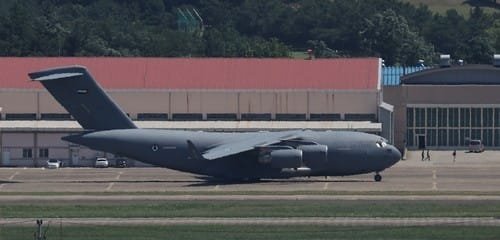
This episode does not demonstrate that Seoul could have denied the UAE access to interceptors. It demonstrates something more basic: the UAE’s ability to sustain Cheongung-II during a prolonged conflict remained connected to Korean production and delivery capacity. That dependency is the starting point for examining a potential practical veto.
From Localisation to Lifecycle Control
The UAE–South Korea relationship now extends beyond the purchase of finished weapons, but the extent of localisation remains important to distinguish. The memorandum of May 5 2026 between Tawazun and LIG Defense & Aerospace (LIG D&A) proposes a UAE-based entity covering research and development, manufacturing, maintenance support, and supply-chain integration.11 Yet, the agreement is exploratory: it does not establish that a production facility is already operating, nor does it specify that Cheongung-II interceptors will be manufactured in the UAE. LIG D&A itself has indicated that manufacturing remains under consideration, while the initial focus is expected to include research, development, and maintenance.
This distinction is important because the UAE’s role in the Cheongung-II supply chain remains limited. The original 2022 contract placed LIG Nex1 as the prime contractor and systems integrator, with Hanwha Systems responsible for the multifunction radar and Hanwha Defense for launch and transport equipment.12 The system itself is produced through a network of Korean companies.
The emerging UAE partnership could therefore localise parts of the system’s support structure before it localises the system itself. Maintenance, repair, technical support, and selected components can be brought closer to the user, even when the core missile remains manufactured abroad. LIG D&A’s own description describes its lifecycle-support capabilities as encompassing technical manuals and data, supply support, repair parts, depot-level maintenance, and performance upgrades,13 illustrating how broad “sustainment” can be.
The evidence therefore points to the increasing UAE participation in the defence lifecycle but not yet full control of it. It raises a critical question: what happens beyond the UAE-based factory or maintenance facility: who controls the technologies, components, and production capacity on which those local activities depend?
Does Localisation Actually Reduce the Practical Veto?
Localisation does not automatically remove dependence. Its strategic value depends on whether it gives the UAE greater control over inputs that are difficult to be replaced during a crisis. The practical-veto test therefore looks beyond whether activity takes place in the UAE and asks who controls the capability when external supply is disrupted.
| Critical Input | Current Position | Effect on Practical Veto |
| Interceptor Supply | Additional Cheongung-II systems still sourced from South Korea | High External Dependence |
| Maintenance and Repair | UAE-based cooperation being developed | Potentially Weaker |
| Critical Components | Public evidence of UAE control remains limited | Unclear |
| Software and Technical Data | Extent of transfer not publicly established | Unclear |
| Production Capacity | UAE manufacturing hub being explored, not yet demonstrated as operational | Potentially Weaker in Future |
| Export and Licensing | Korean-origin systems remain subject to external controls | External Dependence remains |
This framework reveals why local production and autonomy are not synonymous. Consider two hypothetical outcomes. If a UAE facility can manufacture a complete interceptor using domestically controlled technology and locally available components, an external supplier’s ability to constrain replenishment would fall substantially. If the same facility assembles a missile, whose software, key components, or production technology remain controlled abroad, the location of assembly changes, but the underlying dependency does not.
The distinction is particularly important for technology transfer. Receiving equipment or manufacturing instructions can improve local capability without giving the recipient the knowledge required to modify or independently develop the technology. Defence industrialisation can therefore produce greater resilience without complete independence.
The UAE’s emerging relationship with South Korea appears to offer movement in this direction, but its effect should be understood as a spectrum rather than a binary shift. Greater domestic maintenance capacity can reduce one dependency, even while foreign control over missiles or specialised technologies remains. Likewise, having Korean and American suppliers can make disruption by any single supplier less damaging without making the UAE self-sufficient.
The most plausible near-term outcome is therefore not the disappearance of the practical veto but its fragmentation. The UAE may become less vulnerable to a single point of external control as more stages of the defence lifecycle are distributed across UAE-based facilities and multiple foreign partners. Whether that eventually becomes genuine autonomy depends on whether localisation reaches technologies and inputs that cannot easily be substituted in a crisis.
Also Read: From Battery Rules to Data Governance: How the EU Is Reshaping China-Europe Supply Chains
Conclusion
The UAE–South Korea partnership is significant not because it removes the UAE from the global defence market, but because it may alter how dependence is distributed within its air-defence system. The distinction matters. A country can become better equipped to maintain and sustain a foreign-designed capability without becoming fully independent of its supplier.
The UAE’s emerging industrial relationship with South Korea therefore points towards a more gradual form of autonomy, in which vulnerability is reduced at some points in the supply chain while remaining at others. This makes “practical veto” less a question of who supplies a weapon than who can still constrain its continued use. For the UAE, the long-term significance of localisation will ultimately depend on whether industrial cooperation develops into meaningful control over the technologies and inputs that are hardest to be replaced in a crisis.
- Hussain, Zain, and Pieter D. Wezeman. 2026. “The Role of Imported Arms in the Iran War: A Q&A with Zain Hussain and Pieter Wezeman.” Stockholm International Peace Research Institute (SIPRI), March 18, 2026. https://www.sipri.org/commentary/topical-backgrounder/2026/role-imported-arms-iran-war-qa-zain-hussain-and-pieter-wezeman ↩︎
- George, Mathew, Katarina Djokic, Zain Hussain, Pieter D. Wezeman, and Siemon T. Wezeman. 2026. Trends in International Arms Transfers, 2025. SIPRI Fact Sheet. Stockholm: Stockholm International Peace Research Institute, March 2026. https://www.sipri.org/sites/default/files/2026-03/fs_2603_at_2025.pdf ↩︎
- Defense Acquisition Program Administration (DAPA). 2022. “Signing of MOU for Mid-to-Long-Term Cooperation in Korea-UAE Defense Industry and Defense Technology and Successful Export of Cheongung-2 (M-SAM-2).” January 18, 2022. https://www.dapa.go.kr/dapa/doc/selectDoc.do?bbsSeq=326&docSeq=14562&menuSeq=3069 ↩︎
- Ministry of Foreign Affairs, United Arab Emirates. 2025. “Joint Declaration between the Republic of Korea and the United Arab Emirates on the Occasion of the State Visit to the United Arab Emirates by H.E. Lee Jae Myung, President of the Republic of Korea.” November 18, 2025. https://www.mofa.gov.ae/en/MediaHub/News/2025/11/18/18-11-2025-uae-korea ↩︎
- EDGE Group. 2026. “EDGE and Republic of Korea’s DAPA Advance Major Defence Cooperation.” February 27, 2026. https://edgegroup.ae/news/edge-and-republic-koreas-dapa-advance-major-defence-cooperation ↩︎
- Emirates News Agency (WAM). 2026. “Tawazun, Korean LIG D&A Sign MoU to Establish Global Defence Manufacturing Hub in UAE.” May 5, 2026. https://www.wam.ae/en/article/c025vmo-%60tawazun-korean-lig-da-sign-mou-establish-global ↩︎
- Kang, Gahui. 2026. “UAE Uses Korean Defense System to Intercept Iranian Missiles.” Korea.net, March 4, 2026. https://www.korea.net/NewsFocus/Business/view?articleId=288266 ↩︎
- International Institute for Strategic Studies. 2026. “Mind the Air-Defence Gap: South Korea’s Burgeoning Role in Air and Missile Defence.” March 27, 2026. https://www.iiss.org/online-analysis/military-balance/2026/03/mind-the-air-defence-gap-south-koreas-burgeoning-role-in-air-and-missile-defence/ ↩︎
- Cho, Yong-jun. 2026. “Korean Interceptor System Posts 96% Success Rate in UAE Defense against Iranian Strike.” Korea JoongAng Daily, March 6, 2026. https://www.koreajoongangdaily.com/business/korean-interceptor-system-posts-96-success-rate-in-uae-defense-against-iranian-strike/12618152 ↩︎
- Chosun Daily. 2026. “Cheongung-II Missiles Sent Early to UAE After Proven Combat Effectiveness.” March 9, 2026. https://www.chosun.com/english/national-en/2026/03/09/3V7K5SSZCREIJB2UCTV3XUUP4Q/ ↩︎
- Kim, Min-young. 2026. “Combat-Proven Missile Interceptor Deal Drives LIG’s R&D Push in UAE.” Korea JoongAng Daily, May 6, 2026. https://www.koreajoongangdaily.com/korea/combat-proven-missile-interceptor-deal-drives-ligs-rd-push-in-uae/12602596 ↩︎
- Shukla, Parth. 2022. “South Korea Secures Cheongung II Deal with UAE.” Janes, January 19, 2022. https://www.janes.com/defence-intelligence-insights/defence-news/security/south-korea-secures-cheongung-ii-deal-with-uae ↩︎
- LIG Defense&Aerospace. n.d. “MRO (Maintenance Repair Overhaul).” Accessed September 1, 2026. https://www.ligdefenseaerospace.com/eng/business/mroList.do ↩︎